1 Samuel 23:18-21
A translation into Ngalakan
Sadly, the Ngalakan language was extinct by the early 2000’s. For more information, you can read the previous post:

Otherwise, on with the show.
Sources:
Merlan, Francesca, Ngalakan Grammar, Texts and Vocabulary (Australian National University 1983)
The cheeky Google and Wikipedia glances
Bible Hub (as always)
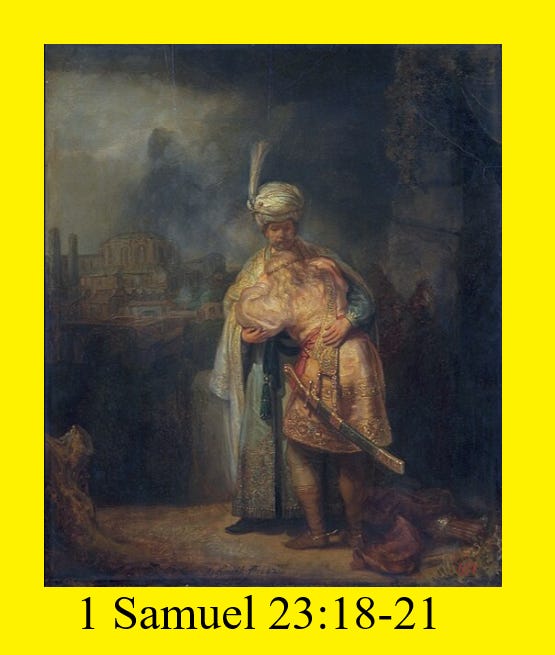
Picture: David and Jonathan by Rembrandt, 1642
1 Samuel 23:18
KJV: And they two made a covenant before the LORD: and David abode in the wood, and Jonathan went to his house.
Ngalakan. Burmudačmiñbira mungujaka’ Weleŋ yuka. Ńaniñ Ńuguwaļga guɖaŗ’ɖaŗka’, wakeñ Ńugumubu ŗereńowika’.
Burmudačmiñbira mungujaka’ Weleŋ yuka = the two made a pact before the Lord
Burmudačmiñbira = the two of them cut.
mungujaka’ = yam-stick.
Weleŋ = Yahweh/Lord.
yuka = in front.
In this sentence, “made” comes from Hebrew kah-rath (כרת) to cut off, to cut down.
The first appearance of this verb is:
[God said to Noah]: And I establish My covenant with you: Never again shall all life BE CUT OFF by the waters of a flood; never again will there be a flood to destroy the earth.
- Genesis 9:11 BSB
Burmudačmiñbira has four components:
1. burmu- = they do to it (Mu-).
2. dač = cut.
3. -miñ = Past Punctual.
4. -bira = two people.
Here is another appearance of kah-rath (כרת) to cut off, to cut down:
Now at a lodging place along the way, the LORD met Moses and was about to kill him. But Zipporah took a flint knife, CUT OFF her son’s foreskin, and touched it to Moses’ feet. “Surely you are a bridegroom of blood to me,” she said.
- Exodus 4:24-5 BSB.
The Ngalakan also practice circumcision, and they have two words for “circumcise”, these being ɖiţač and bańɖariwu, which comes from bańɖari circumcised/initiated man or young man.
“Covenant” or “treaty” comes from Hebrew buh-reeth (ברית), which comes from bah-rah (ברה) to choose, to cause to eat, and to give meat.
In the ancient world, friendships were often secured by sharing food. Here, I turn the act of making a yam-stick into a metaphor for making an agreement to help each other.
Ńaniñ Ńuguwaļga guɖaŗ’ɖaŗka’, wakeñ Ńugumubu ŗereńowika’. = David stayed at Horesh, and Jonathan went home
Ńaniñ = he stayed.
Ńuguwaļga = David.
guɖaŗ’ɖaŗka’ = in the woods.
wakeñ = he returned.
Ńugumubu = Jonathan.
ŗereńowika’ = to his camp.
I wanted to include the latter verse because it is rare that one gets to reference the Bridegroom of Blood episode, which is possibly the strangest in the whole Old Testament. There are a number of more complete versions, and in one of them, the Lord sends a giant snake to swallow Moses.
The snake cannot swallow Moses further than his penis, because he was circumcised.
If that is true, then this may be the most extreme reminder to circumcise your son.
Moses’ son is called Gershom, which comes from gah-rahsh (גרש) to drive out or to divorce.
To quote the probably abashed father:
Moses agreed to stay with the man, and he gave his daughter Zipporah to daughter to Moses in Marriage. And she gave birth to a son, and Moses named him Gershom, saying, “I have become a foreigner in a foreign land.”
- Exodus 2:21-2 BSB.
This may go some way to explaining why he did not circumcise the young man on the eighth day.
1 Samuel 23:19
KJV: Then came up the Ziphites to Saul in Gibea, saying, Doth not David hide himself with us in strong holds in the wood, in the hill of Hachilah, which is on the south of Jeshimon?
Ngalakan: Gubuju’wala bigur burubolkmiñ Gubińkaga Ńugugaŋawi, buruyiniŋiñ, “Ńuguwaļga gorčaŋan yirkańi’ga’ gugalaka’ guɖaŗ’ɖaŗ’ga, guŋayiwurka’ Mumuńunga’, walam guńɖu guļum’miñ.
Some translations say “Horesh”, some say “forest” or “woods”.
The same applies to “Jeshimon” in this verse, and “Selahammahlekoth” in the final verse of this passage.
Gubuju’wala bigur burubolkmiñ Gubińkaga Ńugugaŋawi, buruyiniŋiñ = some men came up from Ziph and went to Saul at Gibeah, and they said
Gubuju’wala = from Ziph.
bigur = man.
burubolkmiñ = they came out.
Gubińkaga = towards Gibeah.
Ńugugaŋawi = to (see) Saul.
buruyiniŋiñ = they were saying.
In the Bible, there are three cities called Gibeah: one in the lands of Judah, one in the lands of Benjamin and one in the lands of Ephraim. This is the one in Judah, as Saul will confirm later in this passage.
“Gibeah” comes from Hebrew ghib-aw (גבעה), which comes from the same word meaning hill or little hill.
Ngalakan gubiń = English rock, hill, stone and money.
The text does not specify whether these men received payment for the information.
The fact that Gubiń looks very close to Gibeah is a coincidence, and a welcome one at that.
This section has two verbs: burubolkmiñ and buruyiniŋiñ. They both begin with the 3rd Person Intransitive Prefix buru-.
This leaves us with bolkmiñ emerged and yiniŋiñ said.
For bolk emerge, I use the Past Punctual bolkmiñ because once the two men left Ziph to betray David, there was no going back.
For yini say, do (thus), I use the Past Continuous yiniŋiñ to emphasise the added uncertainty: will these men give David away?
Ńuguwaļga gorčaŋan yirkańi’ga’ gugalaka’ guɖaŗ’ɖaŗ’ga = David is hiding among us in the strongholds at Horesh.
Ńuguwaļga = David.
gorčaŋan = he hides.
yirkańi’ga’ = among us.
gugalaka’ = in the strongholds
guɖaŗ’ɖaŗ’ga = in the woods.
Next, I want to discuss yirkańi’ga’. It ha two components:
1. yirkańi’ = 1st Person Non-Singular Exclusive.
2. -ga’ = Locative Case.
Ngalakan has four 1st Person Pronouns:
1. Singular ŋaykańi.
2. Dual Inclusive yikańi.
3. Plural Inclusive ŋurkańi.
4. Non-Singular Exclusive yirkańi.
We have nowhere near enough time to explore every aspect of Ngalakan pronouns. For example, these are the Ergative forms, to which you add another case suffix.
If you want the Absolutive stem, just drop the final -ńi. Pronouns take the same case suffixes as Nouns, but they go on the Ergative forms, not the Absolutive.
Here, all I will discuss is the difference between Exclusive and Inclusive. In simple terms:
Inclusive = me and you.
Exclusive = me and them.
Now, you may have noticed that the Inclusive makes a Dual-Plural Distinction, while the Exclusive squishes them both into the Non-Singular.
This is relatively typical for languages from Northern Australia.
guŋayiwurka’ Mumuńunga’, walam guńɖu guļum’miñ = on the hill at Hachilah, to the south of Jeshimon.
guŋayiwurka’ = on the high hill.
Mumuńunga’ = at Hachilah.
walam = in the south.
guńɖu = the country.
guļum’miñ = (that is) peeled.
“Hachilah” comes from Hebrew kha-kee-lah (חכילה), which comes from khak-lee-lee (חכליל), which means dull or red.
This khak-lee-lee (חכליל) only appears once as a verb. It comes from Jacob’s speech on his deathbed.
Judah is a young lion – my son, you return from the prey. Like a lion he crouches and lies down; like a lioness, who dares to rouse him? The scepter will not depart from Judah, nor the staff from between his feet, until Shiloh comes and the allegiance of the nations is his. He ties the donkey to the vine, his colt to the choicest branch. He washes his garments in wine, his robes in the blood of grapes. His eyes ARE DARKER than wine, and his teeth are whiter than milk.
- Genesis 49:9-12 BSB
I gave kha-kee-lah (חכילה) the translation mu-muńun darkness, obscurity or black and lustreless.
Up until now, I have translated all of the Place names as Gu-Class nouns. This is one exception.
There does exist a Gu-class alternative – gu-guńmuk night or dark – if you want to make it conform to the rule.
“Jeshimon” comes from yeh-shee-mone (ישיםון) desert, solitary, wilderness, and it comes from yaw-sham (ישם), whose meanings include appalled, desolate and stripped.
I give yeh-shee-mone (ישיםון) the translation guļum’miñ, which has three components:
1. gu- = Gu-Class Absolutive Prefix.
2. ļum’ = strip bark off a tree.
3. -miñ = Past Punctual.
Now, I don’t want to brag, but I actually made up the phrase “Absolutive Prefix”. It does not occur in Merlan’s grammar. You use it if a Gu-Class Noun is the Subject of an Intransitive Verb, or the Patient (a.k.a. Object) of a Transitive Verb.
Most trees are in Gu Class.
So what is the Absolutive?
Earlier, I used this example to help you understand the Ergative:
Ńuguwaļga-yi’ ńa’ńa Ńugugaŋa = David saw Saul.
Ńuguwaļga ńa’ńa Ńugugaŋa-yi’ = Saul saw David.
If you look closely, the Ergative Suffix -yi’ switches places between Ńuguwaļga David and Ńugugaŋa Saul.
Now, only one can carry the Ergative -yi’. The other one is the Absolutive.
1 Samuel 23:20
KJV: Now therefore, O king, come down according to all the desire of thy soul to come down; and our part shall be to deliver him into the king’s hand.
Ngalakan: Ŋiñɖoɖo’ŗagan guruyana’mala, gulukuluyere? Yiriwańawuna gungumaŗjiyi’ ńugugulukulu’gun.”
This is one verse that I thought would be very frustrating, but the final result was exceptionally streamlined.
Ŋiñɖoɖo’ŗagan = you wish to go down.
This word has four components:
1. Ŋiñ- = thou.
2. ɖoɖo’ = go down.
3. -ŗa = Future.
4. -gan = Subordinate/Dative.
Without going too deeply into the Ngalakan grammar, the -gan at the end of Ŋiñɖoɖoŗagan is the same as the -gun at the end of ńugugulukulu’gun.
The Suffix -gVn (the capital V simply means that it takes the previous vowel.) When you add it on the end of a verb, it indicates desire or intention.
Unfortunately, I could not find a way to translate the Hebrew neh-fesh (נפש) breath, which stretches out to soul, life, living being and furthermore to desire, since the will to live is very important.
Neh-fesh (נפש) appears four times in Genesis chapter 1, and twice in chapter 2.
Hebrew yah-rahd (ירד) = Ngalakan ɖoɖo’.
Both verbs roughly translate as bring down or come down in English.
The first two appearances of this verb are in Genesis chapter 11:
Then the Lord CAME DOWN to see the city and the tower that the sons of men were building. And the Lord said, “If they have begun to do this as one people speaking the same language, then nothing they devise will be beyond them. Come let Us GO DOWN and confuse their language, so that they will not understand one another’s speech.”
- Genesis 11:5-7 BSB.
guruyana’mala = exactly when?
The first decision I made was to turn the first part of this phrase into a question. On BibleHub, not one of the parallel verses included a question in this verse. I am truly going off the rails, and you are here for it.
Anyway, guruyana’mala has two components:
1. guru- = exactly.
2. yana’mala = when?
In addition, yana’mala also has two components:
1. yana’ = what.
2. mala = season/time (Ngandi).
Ngandi is one of Ngalakan’s closest relatives.
Anyway, Ngandi mala may be related to Ngalakan maļar sweet or ripe.
The men from Ziph are asking Saul if the time is ripe, but are they pushing him along?
gulukuluyere = our king.
This has two components:
1. gulukulu = king/boss/countryman.
2. -yere = ours (mine + theirs).
In Hebrew and English, the “our” in “our king” is ambiguous, because the person to whom you are talking may have the same king or a different one.
In this context, however, it is not.
In Ngalakan, that ambiguity does not exist.
Yiriwańawuna = we will give him.
Yiriwańawuna has three components:
1. yiri- = we.
2. wańa- = for a long time.
3. wuna = will give.
The second part of this verse is where it enters its stride. Look at the alliteration of those final two parts.
gungumaŗjiyi’ = with our hands.
This has three components:
1. gungu- = Gu-Class long Prefix.
2. marji = hand.
3. -yi’ = Instrumental.
Some of you may notice that the Instrumental Case Suffix is the same as the Ergative Case Suffix. This is not unusual for Aboriginal languages.
It’s the same suffix, but you call it the Instrumental when you add it to an inanimate noun.
ńugugulukulu’gun = to the king.
This has three parts:
1. ńugu- = Masculine Long Prefix.
2. gulukulu = king/boss/countryman.
3. -gun = to.
In case you forgot, all Class Prefixes have a long form and a short form, with the short form being ńu-.
Furthermore, these prefixes are optional. This means that I chose to end this sentence with a seven-syllable word.
Have fun trying to say it.
1 Samuel 23:21
KJV: And Saul said, Blessed be ye of the LORD; for ye have compassion on me.
Ngalakan: Ńugugaŋa yiniñ, “Ńurumuɖuɖu’je Weleŋyi’ ŋunļibanabanar.”
Ńugugaŋa = Saul.
yiniñ = said.
Ńurumuɖuɖu’je = You are blessed.
Weleŋyi’ = by Yahweh.
ŋunļibanabanar = he has compassion on me.
“Bless” comes from Hebrew bah-rak (ברך) to kneel, and that stretched to mean bless God or bless man, and this even became a euphemism meaning curse.
Ńurumuɖuɖu’je has three components:
1. ńuru- = You (Non-Singular).
2. muɖuɖu’ = on one’s knees.
3. -je = made stand.
The final -je is the Past Punctual of -ja, which means make stand. It can’t appear by itself, it requires something directly behind it. This means that if a single man or a single woman is keeling by him or herself, you add the prefix gu-, after gu-buń kneecap.
I made ŋunļibanabanar from three components:
1. ŋun- = he does to me.
2. ļi- = Poor Thing.
3. banabanar = thinks.
The second prefix ļi- (Long Form: wiļi-) is called the Compassion Prefix. This does what the name suggests: it indicates the speaker has compassion on the thing to which he refers.
The way that I use it here – Saul saying that God has compassion on him – is very atypical.
Secondly, Ngalakan does not have a (general) word for “think”. Like many Australian languages, it gives the word for “hear” extra duties.
That said, Ngalakan does have bakmengol to think about someone or be concerned for someone, which is a compound built from men mind.
In this context, I prefer banar hear, because Saul has spent the whole time praying to God for victor against David. Plus, he’s probably a bit suspicious of the Ziphites, so if he can put the fear of God into them, so much the better.