Mark 3:1-4
A translation into Fwe

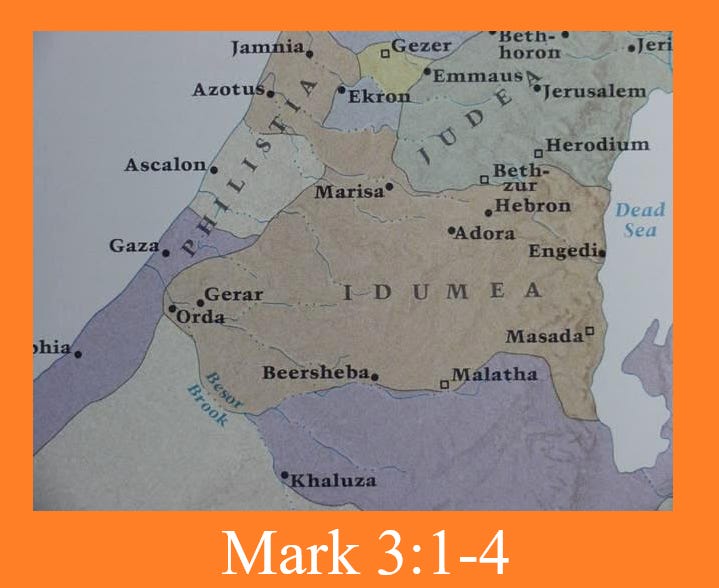
This marks the first time where I translated the entire passage before going back over to describe and justify my decisions. Before I did each verse one at a time, often flicking backwards in order to make corrections and harmonise any stylistic choices.
The Fwe language is native to the Zambezi region of Namibia, and across the border in the Imusho, Sinjembela and Mutomena areas of Zambia. The Western boundary of the Fwe language is the Kwando River, which is also the border between Zambia and Angola.
The former name for the Zambezi region is the Caprivi Strip. You can see this on regional maps of Southern Africa. It’s that weird isthmus that hangs off the edge of Northern Namibia.
Fwe belongs to the Niger-Congo language family, the largest in the world (in terms of number of languages). Languages in this family are very difficult to classify – because they keep talking to each other.
Languages similar to Fwe include Shanjo, Mbalangwe, Subiya and Totela, with Shanjo being Fwe’s closest relative.
The Few language has around 15,000 speakers, and though this seems small, the language has a high vitality. Gunnink predicts that Fwe will settle into comfortable multi-lingualism for the short- to medium-term future.
An official Fwe Bible was being prepared when Gunnink wrote her grammar. I did not use this in my research.)
A note on spelling:
I made a few spelling alterations from Hunnink’s grammar:
/ng/ => /ŋg/
and
/sh/ => /š/
/c/ => /č/
/zy/ => /ž/.
The last three carry a mark called the Caron or hacek (little hook in Czech).
I use it because it looks like a pair of outstretched arms, trying to grab at the hem of his cloak.
Sources:
Gunnink, Hilde, A grammar of Fwe: A Bantu language of Zambia and Namibia (Ghent: University Press 2018)
The cheeky Google search
Tree-lore comes from:
Feedipedia
Plant ZAfrica
Mark 3:1
KJV: And he entered again into the synagogue; and there was a man there which had a withered hand.
Fwe. Hape nakabiri mwinjuo mušangana, naken’ omuntu nanja rížumi,
again, he went into the synagogue = hape nakabiri mwinjuo mušaŋgana
hape = again
nakabiri = he entered
mwinjuo = into the house
mušaŋgana = of meeting
synagogue comes from Greek συναγωγή sunagōgē. This has two components:
1. συνάγω = to bring together.
2. γη = place .
I built mwinjuo mušaŋgana into the synagogue from three components:
1. mu- = into [x2].
2. njuo = a house.
…
3. šaŋgana = to meet.
mušaŋgana for [the purpose of] meeting is very close to rušaŋgani Salsola aphylla.
What is Salsola aphylla?
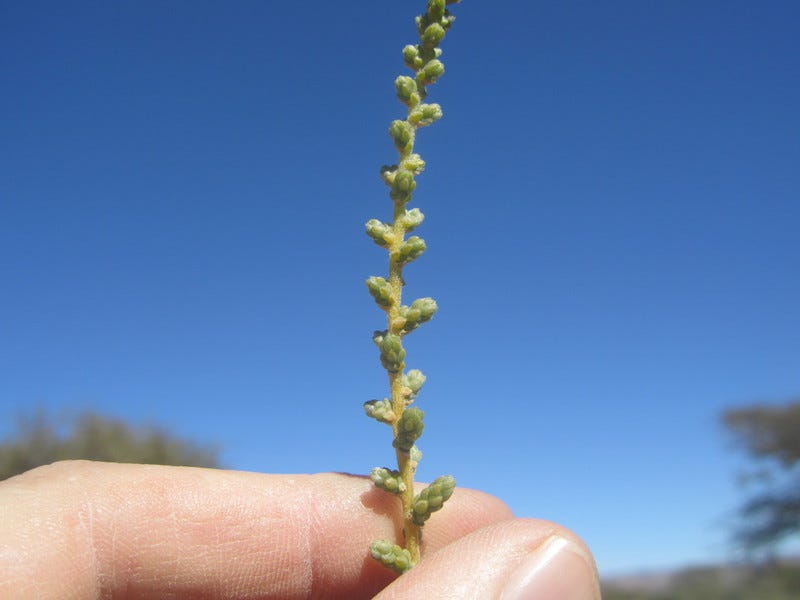
Its English names include Ganna bush, Lye bush, Lye ganna, and variations on both.
It has at least two dozen names in Afrikaans, most of which include /ganna/.
Its native home stretches across South Africa, Botswana and Namibia.
Rušaŋgani grows in deserts and dry places, and drinks the groundwater beneath your feet. Even when the rest of the Karoo looks dead and done for, rušaŋgani endures, and is the last food source for many animals.
Similarly, when the Jews suffered under the rule of foreign powers, and had to endure the presence of foreign soldiers in their temples, the more informal meeting places provided a small refuge of
and there was a man with a withered hand = naken’ omuntu nanja rížumi
naken’ = and there was
omuntu = a man
nanja = with a hand
rížumi = that had dried up
withered comes from Greek ξηραίνω (xērainō) to dry up, to waste away.
Fwe kužuma to dry up is but one consonant away from kužuba to peel.
We can imagine that his skin is probably peeling off.
Furthermore, both /m/ and /b/ are Bilabial consonants – this means that you make them by peeling the lips away from each other.
In addition, kužuma is the basis of kužuminia to dry grains/wood.
The latter also means to be unconscious.
Mark 3:2
KJV: And they watched him, whether he would heal him on the Sabbath day; that they might accuse him.
Fwe. kekwesi irwera kubona iye eye amutuse Hežuba Hažimana, iye bamuhambike.
and they were watching him to see if he would cure him = bakwesi barwera kubona iye eye amutuse
bakwesi = they were doing
barwera = they watched
kubona = to see
iye = him/so that
eye = him/he
amutuse = he would cure him
Fwe iye/eye = English he/she/him/her. (It can only refer to humans)
Fwe okuteye/iye = English that/so that/if.
I use the ambiguity of eye/iye to even greater effect below.
on the Sabbath day, so that they could accuse him = Hežuba Hažimana iye bamuhambike
Hežuba = on the day
Hažimana = of rest
iye = so that
bamuhambike = they could accuse him
Sabbath comes from Hebrew shawbath (שבת) to cease, to desist, to rest.
I build Hežuba Hažimana from four components:
1. ha- = on [x2]
2. ežuba = sun/day.
…
4. žimana = to stop/to stand/to be pregnant.
The Verb kužuba means to peel.
Ežuba rirížub’ ežuba. = The sun peels the day OR the day peels the sun.
But don’t look stare directly at the sun (žuba), or get lost in counting the days (mažuba). If you do, you might get lost (kužoba) in the clouds (mažoba) of confusion.
kužimana = to stop/to stand/to be pregnant.
The Sabbath day is when we are supposed to slow down, lean back (žiama), stop (žimana) what we are doing, and think about how we have or have not served the Lord to our utmost.
(Of course, we are supposed to do this all the time, but God understands that we have trouble. This is why he created the Sabbath. It serves us be forcing us to rest.)
When we do this with our whole hearts, we are reborn in God, and God is reborn in us.
Matthew 12:48-50 BSB
But Jesus replied, “Who is My mother, and who are My brothers?” Pointing to His disciples, He said, “Here are My mother and My brothers. For whoever does the will of My Father in heaven is My brother and sister and mother.”
(We will meet Mark’s version of this same scene at the end of this very chapter.)
Mark 3:3
KJV: And he saith unto the man which had the withered hand, Stand forth.
Amuta nanja netore, “Nanuke hakati.”
Amuta = he says to him
nanja = with the hand
rížumi = that had dried up
Nanuke = stand up!
hakati = in the middle
amuta as three components:
1. a- = he.
2. mu- = to him.
3. ta = says.
stand forth comes from Greek εγείρω (egeirō) wake, around, raise up.
All 4 Gospels use the same verb to talk about Jesus rising from the dead.
Mark 3:4
KJV: And he saith unto them, Is it lawful to do good on the Sabbath days, or to do evil? to save life, or to kill? But they held their peace.
Fwe. Nabata, “Uziminizete hamažuba hažimana: kurotu kapa kumaŋgo? hužu kuhaza kapa kuyaya?” Banarižuminizi.
he says to them, “is it permitted on the Sabbath days = nabata, “Uziminizete hamažuba hažimana
nabata = and he says to them
Uziminizete = are you allowed
hamažuba = on the days
hažimana = of rest
permitted or allowed comes from Greek έξεστι (exesti) to be possible, to be lawful/permitted. This is the root of English to exist.
uziminizete has three components:
1. u- = thou.
2. ziminiza = to allow.
3. -ite = be.
With uziminizete, Jesus is asking a single person if he or she is allowed to do X.
If He wanted to ask two or more people at the same time, he would use muziminizete.
So why choose u- over mu-?
The original Greek uses the impersonal is IT lawful…?
Fwe has at least 9 Prefixes that translate to English it, based on Noun Class.
u- is the Subject Prefix for Noun Class 3.
Fwe miraho = English law.
You can guess the Noun Class to which it belongs.
miraho comes from Lozi, a neighbouring language.
to do good, or to do evil? to save life or to kill? And they were silent. = kurotu kapa kumaŋgo? hužu kuhaza kapa kuyaya?” Banarižuminizi
kurotu = to do good
kapa = or [x2]
kumaŋgo = to do evil
hužu = breath
kuhaza = to save
kuyaya = to kill
banarižuminizi = they kept quiet
kurotu and kumaŋgo both begin with the Infinitive Suffix ku-.
-rotu and –maŋgo correspond to English good, beautiful and bad, ugly respectively.
I include this grammatical excursion for the simple reason that I do not know whether Fwe actually allows this. I could check, but there’s a possibility that the grammar might say no.
life comes from Greek ψυχή (psuchē) breath, soul and by extension individual self.
I chose hužu breath over buharo life because it comes before kuhaza to save, and I like my alliteration.
English to kill = Fwe kuyaa or kuyaya.
Zambian Fwe is more likely to use the second option, but there is no difference in meaning between the two.
I chose the latter because the two short /ya/’s next to each other sound like a man struggling to get his final short, raggedy breaths out.
banarižuminizi has four parts:
1. ba- = they.
2. na- = were.
3. rižuminiz = to keep quiet.
4. -i = were.
kurižuminiza also corresponds to the following:
1. to pretend to be unconscious.
2. to be ignorant.
These two meanings do not contradict. Doing the former on purpose results in doing the latter by accident.
Furthermore, anyone whose read enough Victorian literature will be familiar with the use of unconscious to mean did not know (i.e. be ignorant).
The only example that comes to mind is that scene in Thomas Hardy’s Far from the Madding Crowd where Bathsheba is waiting for the circus to begin. She believes herself to be a widow, but her husband is, in fact, among the performers.