Proverbs 15:1-5
A Yeri translation

The Yeri language is native to the Sandaun Province in north-eastern Papua New Guinea. Most, if not all, Yeri speakers live in around a dozen hamlets along the River Om. Most maps group these hamlets under the name Yapunda. It is around 25 miles south-southeast of Aitape, the regional capital.
It does not have a bright future ahead, with only the oldest generation of speakers using a non-simplified form of the language. Anyone below 40 can speak only a simplified version of the language, and they prefer to use Tok Pisin.
Yeri belongs to the Torricelli language family.
Usually, I include passages from elsewhere in the Bible to help add flesh to my commentary. I choose these verses based on whatever happens to occur to me while I go along. For the first few verses of this Translation & Commentary, no passages came to mind. At some point, I decided to turn this into a deliberate stylistic choice.
Personally, Proverbs is, on the whole, my least favourite book to read. It feels too much like a compilation of things someone found on www.generic-advice.net, or a real website with a similar name. Partly, I know that this is an example of backwards projection – i.e. these witty aphorisms came from the Book of Proverbs.
In August 2024, I attended the Lambda Conference at the (Anglican) Shrine of our Lady of Walsingham. It was a weekend spent playing ice-breaker games, visiting the beach, and discussing Proverbs. As a result, I appreciate this book much more.
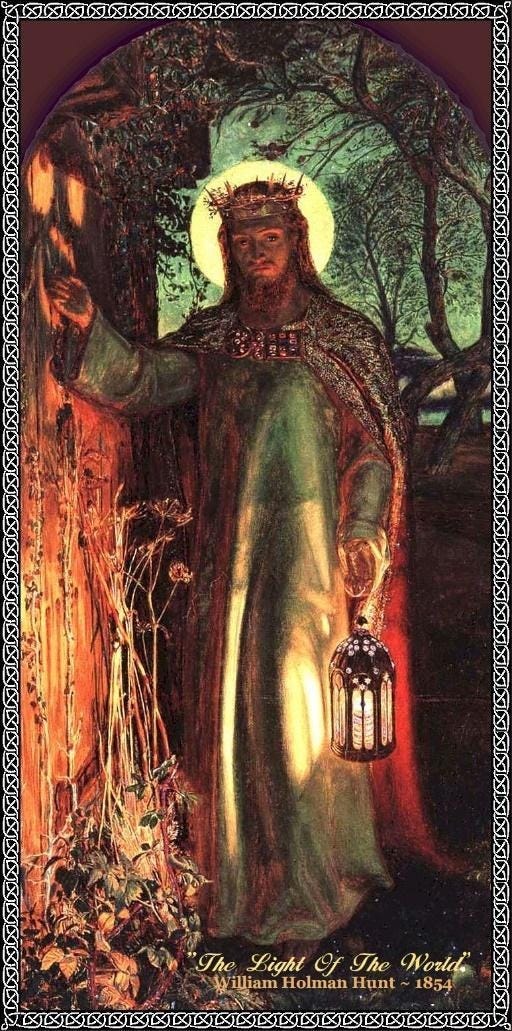
I will explain my inclusion of William Holman Hunt’s The Light of the World later.
Sources:
Wilson, Jennifer, A Grammar of Yeri: a Torricelli language of Papua New Guinea (Buffalo: New York State University 2017
The cheeky Google search
15:1
KJV. A soft answer turneth away wrath: but grievous words stir up anger.
Yeri. Hobɨ wigal wo lapaki: yautietɨ wigal nobatɨn.
hobɨ = soft (small)
wigal = language, speech, words [x2]
wo = she is
lapaki = a pair of tongs
yautietɨ = (big) blunt
nobatɨn = he kindles a big fire
Wrath/anger comes from Hebrew khaymaw (חמה) heat or rage.
You use a lapaki, usually a piece of bamboo broken almost in half, to move coals and other hot items.
nobatɨn has three components:
n- = he.
obatɨ = kindle a fire.
-n = him.
The Yeri word for fire is hasiekɨ, in case it doesn’t pop up later.
Yeri has 2 Genders, Masculine and Feminine. Unlike in the Romance languages, the difference is Productive.
To simplify, a Feminine thing is small, a Masculine thing is big, and you can switch between the two for effect.
15:2
KJV. The tongue of the wise useth knowledge aright: but the mouth of fools poureth out foolishness.
Yeri. Nalia wdi iemaren wogla wan: wualebo tabi nagou.
the tongue of the wise makes knowledge welcome = nalia wdi iemaren wogla wan
nalia = the tongue
wdi iemaren = that clears a garden
wogla = she gets
wan = knowledge
nalia tongue is close to nal a conch shell, which was a traditional instrument for sending messages.
wogla wan has three components:
1. w- = she
2. ogla = fetch (water).
…
3. wan = heart.
This is the Yeri expression for I know.
If you want to say that you don’t know something, the expression is hiro wigla wan.
ogla fetch is similar to ogela to cut open an animal.
the mouth of a fool spews folly = wualebo tabi nagou
wualebo = a fool’s
tabi = mouth
nagou = has a strong smell
The native Yeri word wualebo fool has two components:
1. wual = pig.
2. nebo = dog.
tabi tongue is close to tabiagɨ meat.
15:3
KJV. The eyes of the LORD are in every good place, beholding the evil and the good.
Yeri. Taliawik yewal gamekaria, natri wiluai wodei weinabei.
the eyes of Yahweh are everywhere = Taliawik yewal gamekaria
Taliawik = Yahweh’s
yewal = eyes
gamekaria = are looking everywhere
the Lord comes from Yahweh (יהוה), which means something like He who Is and Is becoming.
I build Taliawik from two components:
1. tawiaki = a long time in the future.
2. lawiaki = a long time ago.
I mixed it around a bit because it pleased me aesthetically. Also, God is present throughout all time and space.
gamekaria has two components:
1. gakaria = to look everywhere.
2. -me- = is doing all the time.
The second part carries the name Imperfective Infix. This indicates something that is still ongoing.
he sees the evil and the good = natri wiluai wodei weinabei
natri = He sees them
wiluai = bad
wodei = and
weinabei = good
natrei has three components:
1. n- = He.
2. atr = see.
3. -i = them.
The /w/ at the start of wilaui and weinabei is different to the /w/ at the start of wodei.
First of all, the /w/ in wodei is optional – it is mandatory in the other two.
In fact, the /w/ in wodei could, if it wanted, go at the start of w-gamekaria.
15:4
KJV. A wholesome tongue is a tree of life: but perverseness therein is a breach in the spirit.
Yeri. Hobɨ nalia wo nebal yewalti: wgiekɨr wgoheti nabia.
a healing tongue is a tree of life = hobɨ nalia wo nebal yewalti
hobɨ = soft
nalia = tongue
wo = she is
nebal = tree
yewalti = eye
I re-use hobɨ soft to link back to verse 1.
nebal yewalti (lit. eye of a tree) is the Yeri term for medicine.
It also refers to any type of fruit or seed, which is no doubt where most traditional medicine comes from.
wgoneti has three components:
1. w- = she.
2. goti = break (like a fishing line).
3. -ne- = him.
The Verbal Prefix w- can mean she or they, depending on context.
crookedness therein breaks the spirit = wgiekɨr wgoheti nabia
wgiekɨr = being bent
wgoneti = she breaks him
nabian = spirit
I add the Masculine Suffix –n to nabia-n spirit.
I make nalia tongue Feminine and nabian spirit Masculine in order to highlight the size difference between the two.
A small bit of crookedness can have an outsize effect.
15:5
KJV. A fool despiseth his father’s instruction: but he that regardeth reproof is prudent.
Yeri. Wualebo wgameradi wigal wdɨ nena: hamote wdɨ wdomedi hiro wdiwialta.
a fool despises his father’s instruction = wualebo wgameradi wigal wdɨ nena
wualebo = fool
wgameradi = she buries
wigal = word/s
wdɨ = (of) her
nena = father.
Both Hebrew and Yeri have two genders: Masculine and Feminine.
In Hebrew, the “default” is Masculine, and in Yeri it is Feminine.
Of course, I made the Yeri fool Feminine in order to maximise alliteration (w-gameradi she buries instead of n-gameradi he buries).
The Yeri word wdɨ has many different (and maybe related) meanings.
This verse contains the two main ones: namely Genitive Pronoun her and the Relative Pronoun who/which/that.
Yeri has two words for her: wdɨ for one thing, and weidɨ for plural things.
he who receives correction is prudent = hamote wdɨ wdomedi hiro wdiwialta
hamote = the person
wdɨ = who
wdomedi = is waiting
hiro = not
wdiwialta = is (not) scared
To make a Yeri verb negative, you add hiro not and change the first vowel. For example:
dawialta = to be scared.
hiro diwialta = to (not) be scared.
hamote individual is Feminine. The Masculine form is hamoten.