1 Samuel 23:22-5
A translation into Ngalakan
Sadly, the Ngalakan language was extinct by the early 2000’s. You can read the full introduction here:

And a link to the previous section will be hidden somewhere in the text. Otherwise, on with the show.
Sources:
Merlan, Francesca, Ngalakan Grammar, Texts and Vocabulary (Australian National University 1983)
The cheeky Google and Wikipedia glances
Bible Hub (as always)
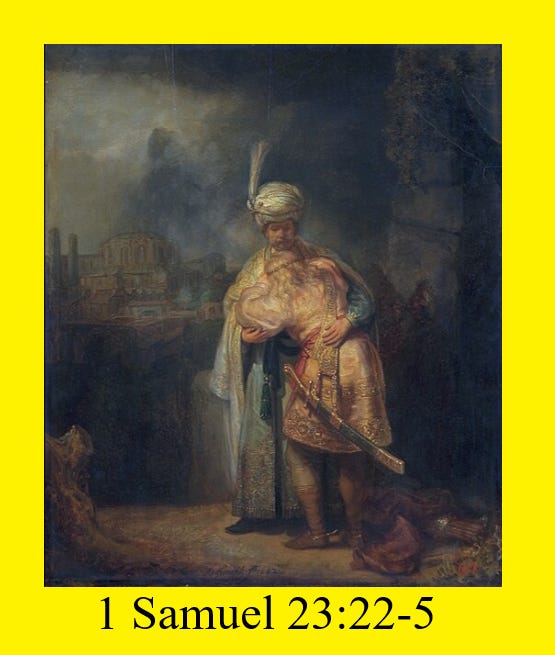
Picture: David and Jonathan by Rembrandt, 1642
1 Samuel 23:22
KJV: Go, I pray you, prepare yet, and know and see his place where his haunt is, and who hath seen him there: for it is told me that he dealeth very subtilly.
Ngalakan: Ńubayapayana, ńugubur’ńaŋani ŗereńowi, ńubeļewana, añji ŋunbuyini’gan guje’jet gumen ńiñjańiyi’.
This translation works, but even I find it baffling, and I can’t quite figure out why.
Ńubayapayana, ńugubur’ńaŋani ŗereńowi, ńubeļewana = Go and see him, know where his camp is, where his haunt is
Ńubayapayana = you will go to see him.
ńugubur’ńaŋani = you will know it (gu-).
ŗere-ńowi = camp-his.
ńubeļewana = you will track him.
Ńubayapayana has three components:
1. ńu = you do to him.
2. bayapaya = go and see.
3. -na = Future.
Bayapaya is the reduplicated form of the Verb baya to look at, to go and see or to come and see. This is my way of translating the Hebrew na (נא) please, for which I could not find a direct comparison.
I build ńugubur’ńaŋani from three components:
1. ńugu- = you do to it (Gu-).
2. bur’ńa = know, understand.
3. -ŋani = Future.
In case you missed 1 Samuel 23:17, Ngalakan does not have an Imperative. You use the Future instead. This is not the only common feature that Ngalakan lacks, as you will see in this same verse.
Ngalakan gu-ŗere camp is my translation of Hebrew mah-kohm (מקום) standing place.
“Hideout” comes from Hebrew reh-gel (רגל) foot, step and a euphemism for genitals. Some of you are snickering at that last one, but is worth noting that David and his men need to urinate somewhere.
I build ńubeļewana from three components:
1. ńu- = you do to him.
2. beļewa = track, follow.
3. -na = Future.
If this word is too easy to say, then you can replace ńu- with ńubu-, giving us ńubeļewana = you will follow them.
To ends this section on a grammatical note, Ngalakan has more than 60 Transitive Verb Prefixes. That sounds like a lot, and it is a lot, but they are very regular. For example:
Masculine/Feminine Object:
2nd Non-Singular: ńu-beļewana = you will track him.
2nd Singular: ju-beļewana = thou wilt track him.
Gu-Class Object:
2nd Non-Singular: ńu-gu-bur’ńaŋani = you will know it.
2nd Singular: ju-gu-bur’ńaŋani = thou wilt know it.
Just replace -gu- with -mu- or -bu- where appropriate.
añji ŋunbuyini’gan guje’jet gumen ńiñjańiyi’ = for I hear that he is crafty and cunning
añji = and.
ŋunbuyini’gan = they tell me.
guje’jet = (that) he sharpens it now.
gumen = the mind.
ńiñjańiyi’ = he does.
Another common feature that Ngalakan lacks is the Passive Mood. I explain:
In the Hebrew, Saul says that David’s cunning is amar elay (אלי אמר) told unto me. This is not possible in Nglakan.
I build ŋunbuyini’gan from three components:
1. ŋunbu- = they do to me.
2. yini’ga = tell someone.
3. -n = Present.
In Ngalakan, never is a man told something – someone has to tell him.
Furthermore, the Verb yini’ga has two components:
1. yini’ = say.
2. ga = take, carry.
People are coming from a long way to give him information about David; information that no doubt varies in quality and usefulness.
The final three words of the Hebrew are arowm yarim hu (i.e. crafty very is-he.) The three words are:
1. arowm (ערום) = crafty.
2. yarim (יערם) = plane tree.
3. hu (הוא) = he is.
The term plane tree refers to Platanus orientalis, a tree that, among other things, gets a new coat of bark every year. Whenever Saul thinks he has David figured out, David does something unexpected.
The final three words of my translation are:
1. guje’jet = (that) he sharpens it now.
2. gumen = the mind.
3, ńiñjańiyi’ = he does.
So first things first, not only does my translation maintain the alliteration into the last word, but it forces you to say /n/ and /ń/ right next to an /ñ/ and another /ń/, all without taking a breath.
Once you perfect this skill, you have a choice: Do you trip up on this tongue-twister in purpose, to make it sound like Saul is flailing around?
Or do you have him say these three words with perfect clarity, making him sound methodical, emphasising that he has thought about it many times over?
But it doesn’t end there.
I built guje’jet from three components:
1. gu- = Gu- Class Absolutive.
2. je’- = Now.
3. jet = sharpen, temper in fire.
As a result, we can get:
Guje’jet gumen. = He sharpens his mind; or He tempers the mind in fire.
In addition, what happens if we replace gu- with mu-?
Importantly, we get the word mu-men stone oven or stones used to heat ground oven.
Remember, the Prefixes gu- and mu- are optional on nouns.
Therefore:
Guje’jet men. = He sharpens the mind; or He tempers his mind in fire.
Muje’jet men. = He singes his oven stones.
Anyone who went to secondary school in the Yookay – or the equivalent in your native country – will remember doing that experiment where you heat a stone above a Bunsen burner and then dunk it in water, and repeat that process for the rest of the hour-long lesson. By the end, the stone may be noticeably smaller, and the flask full of water has a layer of sediment on the bottom.
An oven stone is where you place a stone in a campfire to heat it up. Once it’s hot enough, you dig a hole, put the stones on the bottom, put your food (wrapped in a skin) on top, and the rest of the dirt above, maybe followed by some other stones to stop animals from digging it up.
If you haven’t read Jean M. Auel’s Clan of the Cave Bear series, you really should. I recommend the first five books and the last 200 pages of the sixth. Now, this series takes places across Eurasia around 30,000 years ago, before metal was in widespread use. When these people want a hot drink, they put a stone in the fire, and when it’s hot enough, they drop it in their cup, causing very much the same process as the Bunsen burner experiment, except that you benefit from the minerals in the water.
So where’s this tangent going?
Earlier in this verse we met the Platanus orientalis, which sheds its bark every year and grows it anew.
Like Saul’s moods towards David, the oven stone heats up and cools down several times in one day. Unlike the tree, the stone grows smaller, but its outside changes just as frequently.
Last thing, I have to give a content warning for the Clan of the Cave Bear series by Jean M. Auel. Each book contains scenes of explicit sexual intercourse. This is especially true for the first book: Clan of the Cave Bear.
If you know, you know.
1 Samuel 23:23
KJV: See therefore, and take knowledge of all the lurking places where he hideth himself, and come ye again to me with the certainty, and I will go with you: and it shall come to pass, if he be in the land, that I will search him throughout all the thousands of Judah.
Ngalakan: Wuñjijaŋan gamalabuyka’ añji ńubumiñjiwena, goyi ńububur’ńaŋangan, ńuruwakeni. Guńmań’ guńɖaga’ ńaŋana, ŋuwuļa ńurkańi’ga’, ŋububakbayani garamalk Ńugujeraɖaga’ añji ŋubeļewana.
Wuñjijaŋan gamalabuyka’ añji ńubumiñjiwena = remember all the places where he his hiding
Wuñjijaŋan = he is hidden.
gamalabuyka’ = in the smoky place(s).
añji = and.
ńubumiñjiwena = you will remember them.
Most modern translations say “hiding places”. I prefer “lurking places”.
The aspect that I want to focus on here is gu-gamalabuy smoky place.
Before the destruction of the Second Temple by the Romans, the Hebrews gave Burnt Offerings to the Lord. As C.S. Lewis says in one of his books, the Temple smelt like both an abattoir and a barbeque.
Both Saul and David are making their offerings to the Lord. The smell of smoke also carries the smell of blood, a smell with which both men will become very familiar.
I built ńubumiñjiwena from three components:
1. ńubu- = all of you do to them.
2. miñjiwe = remember.
3. -na = Future.
Now, miñjiwe to remember is a clarified form of miñji think about, worry about or remember.
David is a threat to Saul’s throne, and Saul must deal with this threat himself. If he lets someone else do it, he might lose even more credibility, and that would cause even more instability.
goyi ńububur’ńaŋangan, ńuruwakena = you will come back when you are certain
goyi = being knowledgeable.
ńububur’ńaŋangan = when you know them.
ńuruwakena = you will return.
I build ńububur’ńaŋangan from three components:
1. ńubu- = you…them.
2. bur’ńaŋan = know, understand.
3. -gan = when.
Meanwhile, I built ńuruwakena from two components:
1. ńuru- = all of you.
2. wakena = will return.
This section reinforces what I pointed out previously. Saul must clamp down on individual initiative in order to maintain law and order. Of course, it would be remiss of me not to mention that the same instincts that caused this conflict in the first place. Saul’s jealousy began when David slew Goliath by himself: he used a sling, which no-one else had thought to do before.
Guńmań’ guńɖaga’ ńaŋana, ŋuwuļa ńurkańi’ga’ = if he is in the country, I will go with you
Guńmań’ = maybe.
guńɖaga’ = in the country.
ńaŋana = he will be.
ŋuwuļa = I will go out.
ńurkańi’ga’ = with you.
Ngalakan does not have a dedicated Conditional construction. For the Present Tense, you smash two Future Verbs together, preceded after guńmań’ maybe.
Before moving on, I would like draw attention to this phrase as a whole:
Guńmań’ guńɖaga’ ńaŋana, ŋuwuļa ńurkańi’ga’, ŋububakbayani garamalk Ńugujeraɖaga’ añji ŋubeļewana. = If he is in the country, I will go with you, I will search every tribe in Judah and track him down.
Here is that sentence with only the first letter of each word:
G… g… ń…, ŋ… ń…, ŋ… g… Ń… a… ŋ…
If you ignore the /g/’s and /a/’s, you get a perfect alternation between the /ń/’s and /ŋ/’s.
Now, let’s get back to how I divided it. Here is part 1:
Guńmań’ guńɖaga’ ńaŋana, ŋuwuļa ńurkańi’ga’
This has a syllable count that goes: 2 – 3 – 3 – 3 – 4.
Here is the second part:
ŋububakbayani garamalk Ńugujeraɖaga’ añji ŋubeļewana.
This has a syllable count that goes: 6 – 3 – 6 – 3 – 5.
I don’t read poetry in my own time, so I’m not sure where to go with this tangent.
ŋububakbayani garamalk Ńugujeraɖaga’ añji ŋubeļewana = I will search every tribe in Judah and track him down
ŋububakbayani = I will look at them.
garamalk = every skin.
Ńugujeraɖaga’ = in Judah.
añji = and.
ŋubeļewana = I will track him.
I built ŋububakbayani from four components:
1. ŋubu- = I do to them.
2. bak- = Object Promoting Prefix.
3. baya = go and see.
4. -ni = Future.
What is an Object-Promoting Prefix?
Ngalakan has two of these bad boys: bak- and baţa-, but they are not created equal: bak- is far more common.
I understand what it is, but not well enough to explain it to another person, or at least not in a decent number of words.
All that said, the only distinction between the two is that baţa- has a slightly negative cadence, or “Anti-Benefactive” in the jargon, while bak- is neutral.
I translate Hebrew eh-lef (אלף) one thousand, clan, division, family with the Ngalakan gu-malk skin, subsection.
Last, but not least, we have “Judah”, which was easily one of the hardest things I’ve ever had to translate.
Hebrew yeh-hoo-dah (יהודה) comes from yah-dah (דה) give thanks, celebrate.
The name “Judah” first appears in Genesis 29:35
And once more [Leah] conceived and gave birth to a son and said, “This time I will PRAISE the Lord.” So she named hum Judah. Then Leah stopped having children.
After racking my brains and tearing out the last few hairs on my head, I eventually came up with Ńugujeraɖa:
1. ńugu- = Masculine Prefix Long.
2. jeraɖa = women’s song.
The Jeraɖa is a ceremony where all the women get together, and men can neither take part nor even watch it. First, the women lie down in a line, and after that they dance through the night. The women even build shelters and cook food on the ceremony ground. The dance involves a lot of leg slapping, and they take turns painting each other.
Some come back to the main camp naked and covered in paint, while other wear some combination of possum hair loincloths, necklaces, chest braces and headdress tassels. The men and children are not allowed to laugh. The ceremony is only for adult women, though I don’t know if they have to be married or not.
When the women come back, they rub their sweat on their husbands, giving them some protection against illness. They give their husbands three drinks of water: the first he spits out, and the second two he swallows.
1 Samuel 23:24
KJV: And they arose, and went to Ziph before Saul: but David and his men were in the wilderness of Maon, in the plain on the south of Jeshimon.
Ngalakan: Ńugugaŋa’gan walama’wala buruŗabo Gubuju’. Ńuguwaļga bigurńowika’ buruńaŋaniñ yarkyarka’ Mungumiŗ’ga, walam guńɖu’wala guļum’miñ.
Ńugugaŋa’gan walama’wala buruŗabo Gubuju’ = they went ahead of Saul towards Ziph.
Ńugugaŋa’gan = of Saul.
walama’wala = from the face.
buruŗabo = they went.
Gubuju’ = to Ziph.
“In front” or “ahead of” comes from Hebrew pah-neem (פנים) face, and it extends to that preposition. BibleHub points out that the face is the part that turns. It appears over 2,100 times in the Old Testament, including twice in Genesis 1:2.
I build walama’wala from two components:
1. walama = forehead, face.
2. -’wala = Ablative Suffix, i.e. from.
I could have used the Locative Suffix -ka’, but I chose -’wala for obvious reasons.
Also, walama face also looks like walam south, which appears at the end of this verse.
Here is Genesis 1:2 (BSB)
Now the earth was formless and void, and darkness was over the SURFACE of the deep. And the Spirit of God was hovering over the SURFACE of the waters.
I ask, what is the difference between a face and a sur-face?
Ńuguwaļga bigurńowika’ buruńaŋaniñ yarkyarka’ Mungumiŗ’ga = David and his men were in the desert of Maon, in the plain south of Jeshimon.
Ńuguwaļga = David.
bigurńowika’ = and his men.
buruńaŋniñ = they were.
yarkyarka’ = in the desert.
Mungumiŗ’ga = of Maon.
I built bigurńowika’ from three components:
1. bigur = man.
2. -ńowi = his.
3. -ka’ = with.
That last component is the Locative Case Suffix, which Ngalakan uses to mean “with” people. (With a tool or an instrument, you would use the Ergative, but that’s for another time.)
“Maon” comes from Hebrew mah-own (מעון). This has the same origin as mah-ohn (מעון) habitation and Tabernacle.
I build Mungumiŗ’ from two components:
1. mungu- = Mu-Class Long Prefix.
2. miŗ’ = house.
The original meaning of miŗ’ is cave, with house being a recent innovation.
This also gives a contrast to all of the previous Location names, which I assigned to Gu-Class.
walam guńɖu’wala guļum’miñ = which is south of the wastelands.
walam = in the south.
guńɖu’wala = from the country.
guļum’miñ = that is peeled.
If you missed 1 Samuel 23:19, “Jeshimon” comes from the Hebrew word for “wasteland”. I possess two physical Bibles, a King James Version and a New Jerusalem Bible, which is not only Catholic, but says “wasteland”.
According to BibleHub, most English language versions use “Jeshimon”. The only two exceptions on display are the English Revised and American Standard Versions, which use “desert”.
I bring this up because this segment contains a word that I missed.
The original Hebrew says “in the plain on the south of Jeshimon”, or something like that. As you can see, I skipped the word for “plain” for the simple reason that I could not come up with a satisfying translation.
Anyway, the English word “plain” comes from Hebrew ah-rah-vah (ערבה) desert, plain, wilderness, etc…
Similar to “Jeshimon”, some translations say “the Arabah of Maon”.
1 Samuel 23:25
KJV: Saul also and his men went to seek him. And they told David: wherefore he came down into a rock, and abode in the wilderness of Maon. And when Saul heard that, he pursued after David in the wilderness of Maon.
Ngalakan: Ńugugaŋa bigurńowika’ buruļe’meŗiñ. Ńuguwaļga buruyiniñ, ŗabo bińgaga’ ńaŋaniñ yarkyarka’ Mungumiŗ’ga’. Ńugugaŋa banarmiñ ļe’meŗiñ Ńuguwaļga’gan Mungumiŗ’ga yarkyark.
Ńugugaŋa bigurńowika’ buruļe’meŗiñ = Saul and his men were looking for him
Ńugugaŋa = Saul.
bigurńowika’ = and his men.
buruļe’meŗiñ = they were looking for him.
I have mentioned the Past Punctual (PP) and the Past Continuous (PC) several times before. In short, they exist in relation to each other.
This verse has 6 Verbs. Here they are in order:
1. buru-ļe’meŗiñ = they were looking for him. (PC).
2. buru-yiniñ = they told him (PP).
3. ŗabo = he went (PP).
4. ńaŋaniñ = he was staying (PC).
5. banarmiñ = he heard (PP).
6. ļe’meŗiñ = he searched for him (PP).
We begin [1] with Saul and his men looking for David; [2] some people tell David, and [3] he reacts by fleeing to the desert.
In the second part, we begin with [4] David chilling in the desert; [5] someone tells Saul, and [6] he reacts by searching for him somewhere else.
This verse starts with Saul actively pursuing David, who reacts by fleeing into the desert. In the second part, David is NOT pursuing Saul, but because God is on his side, Saul feels compelled to react, and broadens his search.
Now, the more knowledgeable among you will notice that I translate the PC verbs into the Imperfective, and the PP verbs into the Perfective. It’s not a prefect match, but it works well enough in practice.
Ńuguwaļga buruyiniñ, ŗabo bińgaga’ = They told David, and he went down to the rock
Ńuguwaļga = David.
buruyiniñ = they told him.
ŗabo = he went.
bińgaga’ = to the rock.
In this verse, the Hebrew word for “rock” is seh-lah (סלע), whose translations include rock, cliff, crag and many similar.
This word first appears in this passage:
And the LORD said to Moses, “Take the staff and assemble the congregation. You and your brother Aaron are to speak to the ROCK while they watch, and it will pour out its water. You will bring out water from the ROCK and provide drink for the congregation and their livestock.”
So Moses took the staff from the LORD’s presence, just as he had been commanded. Then Moses and Aaron gathered the assembly in front of the ROCK, and Moses said to them, “Listen now, you rebels, must we bring you water out of this ROCK?” Then Moses raised his hand and struck the ROCK twice with his staff, so that a great amount of water gushed out, and the congregation and their livestock were able to drink.
- Numbers 20:7-11 BSB
A while ago, I translated the whole of Numbers Chapter 20 into the Gyeli language of Cameroon. You should be able to find it under the “Africa” tab.
I build bińgaga’ to the rock from gu-biń rock, and I use the same word for Gibeah back in 1 Samuel 23:19.
ńaŋaniñ yarkyarka’ Mungumiŗ’ga = he stayed in the desert of Maon
ńaŋaniñ = he stayed.
yarkyarka’ = in the desert.
Mungumiŗ’ga’ = (in) Maon.
If you thought that reference to 1 Samuel 23:19 was indulgent, I will now direct you to 1 Samuel 23:14, which is the very first verse in this passage.
The very first word in this is wańańaŋaniñ he stayed for a long time.
Here, I omit the Prefix wańa- for a long time because in the next verse, Saul will be a gnat’s breath away from finally catching David.
I included a link to 1 Samuel 23:14 at the start of this article. This link will let you go and see verse 19:

(Adding this 2nd link caused the email length limit warning to pop up.)
Ńugugaŋa banarmiñ ļe’meŗiñ Ńuguwaļga’gan Mungumiŗ’ ga;yarkyark. = When Saul heard this, he pursued David in the wilderness of Maon.
Ńugugaŋa = Saul.
banarmiñ = heard [this].
ļe’meŗiñ = [and] searched for him.
Ńuguwaļga’gan = for David.
Mungumiŗ’ga’ = in Maon.
yarkyark = the desert.
Maon first appears in Joshua 15:55, which is one of 42 verses which list all of the cities that belong to Judah. The other three cities mentioned in this verse are Ziph, Carmel and Juttah.
“Carmel” comes from Hebrew kar-mel (כרמל), which is the Adjective form of keh-rem (כרם) vineyard. By itself, kar-mel (כרמל) normally translates as fertile or fruitful.
After a while I came up with Guwor’wala. This has two components:
1. gu-wor’ = belly.
2. -wala = from.
Without the Gu-Prefix, wor’ becomes the Verb wor’ga carry a child or bear a child. Since this is an extra translation, I can leave it on this first draft.
“Juttah” comes from Hebrew yoo-tah’ (יטה), which comes from naw-tah (נטה) to stretch or to spread out, but it has many applications, including bow down/bend away and even afternoon.
I came up with Jorŋmeŗiñ, which is the Past Continuous form of jorŋ to stretch.
I am satisfied with this second one, and would be happy to use it in an actual translation.
Some of my translations exist in physical form. Click this underlined sentence to find out more.