Proverbs 15:31-3
A Yeri translation
Yeri belongs to the Torricelli language family, and you can read a full introduction here:

If you are so interested, you can peruse the rest of the series by going to the homepage. Otherwise, on with the show.
I must warn you that the Appendix was not originally meant for this passage, but I added it on so that it would be published somewhere.
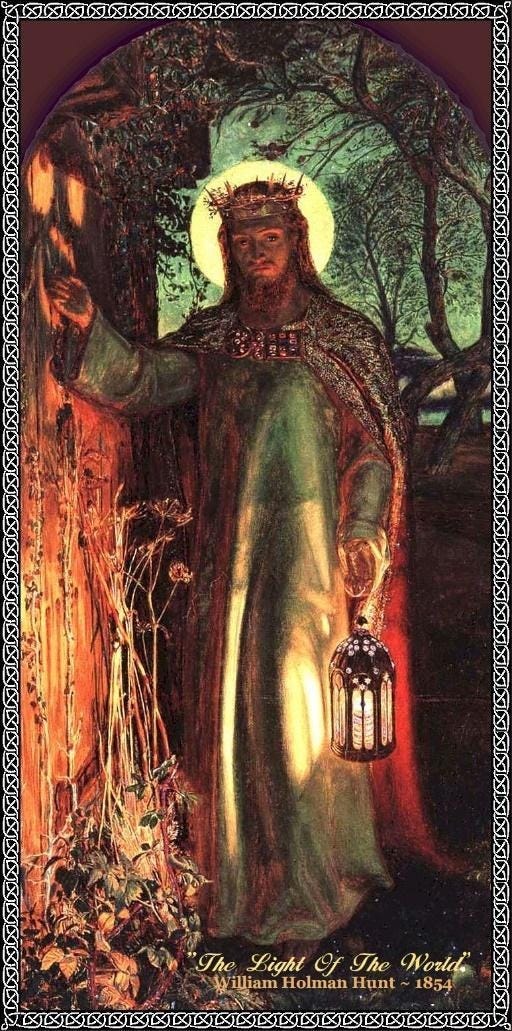
I explained my inclusion of William Holman Hunt’s The Light of the World here:
Sources:
Wilson, Jennifer, A Grammar of Yeri: a Torricelli language of Papua New Guinea (Buffalo: New York State University 2017
The cheeky Google search
15:31
KJV. The ear that heareth the reproof of life abideth among the wise.
Yeri. Megualti nieda wan wdɨ wokɨrki no lapi galgal mani .
Megualti = the ear
nieda = he (that) listens
wan wdɨ wokɨrki = to the helping heart
no = he is
lapi galgal = a strong, dry house
mani = inside
I made megualtɨ ear Masculine for two reasons,
1. the larger you make your ear, the more of God’s instructions you will hear.
2. The Plural of megualtɨ is megual.
English husband = Yeri megual (with the irregular Plural mɨgodi).
Hebrew khawkahm (חכם) = English wise, skilful, learned.
In ancient Israel, a wise man was also expected to have a practical skill. It is no accident that Joseph, the Virgin Mary’s betrothed, was a master carpenter.
Any roof on which he worked kept the people inside safe from rain and strong winds.
15:32
KJV. He that refuseth instruction despiseth his own soul: but he that heareth reproof getteth understanding.
Yeri. Te wohekɨwal wigal weidɨ arki, wde yopeka wosia: te wiedai wigal weidɨ iebeko, te waga wan.
she who avoids instruction hates his own soul = te wohekɨwal wigal weidɨ arki, wde yopeka wosia
te wohekɨwal = she pushes away
wigal weidɨ arki = words that show
wde yopeka = her breath
wosia = dies
Hebrew nefesh (נפש) = English soul, living being, breathing creature, vitality and many similar
Yeri osia = English to swell, to heat up, to die.
he who heeds rebuke gets understanding = te wiedai wigal weidɨ iebeko, te waga wan
te wiedai = she listens to them
wigal weidɨ iebeko = words that block
te waga wan = she gets knowledge
Hebrew layb (לב) = English heart, feelings, intellect, centre.
Yeri aga = English get or buy.
15:33
KJV. The fear of the LORD is the instruction of wisdom; and before honour is humility.
Yeri. Te dawialklan Taliawik, Ten arki yo danua: hewo dawo, haluagɨl garkoi.
te dawialklan = she fears him
Taliawik = Yahweh
Ten arki yo = He shows the way
danua = to her
hewo = on the ground
dawo = sit
haluagɨl = on a mountain
garkoi = run along the edge
Here ends my translation of Proverbs 15 into Yeri, and my commentary thereon.
Appendix
I begin writing this the day after St. Stephen’s Day, 2024. I have translated Psalm 99:5, but have not yet written my workings out.
On Christmas Day I had to work, and on Boxing Day I went around my aunt’s house. While we were there, my cousin’s partner related a story from his time in school. (I forget whether he said primary or secondary school, though in this context it does not matter.)
In this episode, the school invited in an outside speaker to talk about Christianity. My cousin’s partner asked the DQ, which the speaker said was beside the point. He continued to raise the DQ, and they eventually took him outside for being disruptive.
In his teachers’ defence, he was probably being a massive Little Sh*t. Less may have changed since then than he would necessarily admit to.
On the other hand, any teacher dealing with school children should have an answer to the DQ. The failure to do so is a far graver one than most communicators realise.
(One communicator who does realise this is Ken Ham. I’ve only seen one talk by him, and in it he talks about the difference between an Acts 2 Culture and an Acts 17 Culture. We are very much in the latter, and the DQ is one of their stumbling blocks.)
So what is the DQ?
It has nothing to do with the FQ (Feather Question), but has more to do with the other FQ (Flintstones Question). But first, let us back-track.
In my translation of Proverbs 15, I regularly use the worahal as a symbol for righteousness.
To remind you quickly, the worahal is a bird that is well known for cleaning gardens.
Genesis 2:8 BSB
And the LORD God planted a garden in Eden, in the east, where He placed the man He had formed.
In English, we call it the Garden “in” Eden, but perhaps the Garden “in” Eden is a better name. This is a question for another time.
Here are the pressing questions:
Did God plant any other gardens, and did He put other humans in them?
Did anyone else plant their own garden, and make their own humans to put therein?
And most importantly:
Who did it first?
God’s ultimate victory is the Passion. Here, He allowed his enemies to nail him to a tree trunk with a branch going through it. They then planted this tree in a high place so that everyone could see it.
Thus, if Satan and his fellow rebels were to start making gardens first, would that not feed into the same sense of victory through defeat?
The only other mythological garden I can recall from memory is the Garden of the Hesperides. This belongs to Hera, and is where the Gods get their immortality. It also has a tree containing golden apples.
Hera had a rocky beginning. As soon as she was born, her father Chronos gobbled her up, and did the same with 4 of her other siblings. He did not eat Zeus, also her husband, because their mother (Rhea) swapped him for a rock.
As an adult, Zeus got his father to throw up his five siblings – plus the rock, whose fragments still sit around Chronos (also called Saturn) to this day.
Let’s return to the DQ.
Were there other walled gardens present? Did any of them have dinosaurs in them?
Or did the dinosaurs wander in the spaces between the gardens?
Did the dinosaurs suffer their very own Fall?
However, you can’t address the DQ without coming across the third FQ (Fossil Question). This is indeed a challenge. To do this, let us return to the beginning.
In the first 2 chapters of Genesis, we have two origin stories. These seem to contradict, but only if they are referring to the same beginning. We will focus on the more famous 7 Days.
Here’s a question for you: How much time passes between each day?
Answer: It is not specified.
The atheist objection requires the assumption that each day is a 24-hour span of time, each divided by the alignment of two clock hands. This assumption cannot be supported purely in-text.
We skip forward to Noah’s Flood.
God doesn’t do things by magic. He could have whipped up Eve from nothing; He can create Energy from nothing. Instead, he takes Adam’s Rib and creates her out of that. This was to show Adam that they belong to the same flesh in a way that even he couldn’t deny.
Rain fell down from the clouds and water rose up from the caves beneath the ground. The waters were at least 17,000 feet high – about 50 foot higher than Mount Ararat.
A raindrop cannot fall unless it has a piece of dirt inside, and the underground waters probably carried a lot of dirt with them.
The waters from under the earth covered the dinosaurs with mud, and the rainwater compressed and preserved some of them. What elements did the soil contain?
Currently, Oganesson is the heaviest confirmed element in the Periodic Table. It is fully synthetic, and it lives for less than a millisecond.
Oganesson comes from the colliding Californium-249 with Calcium-48.
The most common form of Calcium is Calcium-40, making up 97% of the total, including your bones.
What is the possible reaction between regular Calcium and Oganesson? Does it look like millions of years of ageing?
I leave you with this final question: Is the Flintstones Biblically Accurate?
Sources:
“Mount Ararat Height” on Google
The Oganesson & Calcium Wikipedia pages.
Water Pressure Calculator - Online Calculators (areacalculators.com)