Proverbs 15:6-10
A Yeri translation
Yeri belongs to the Torricelli language family, and you can read the rest of the introduction here:

Usually, I include passages from elsewhere in the Bible to help add flesh to my commentary. I choose these verses based on whatever happens to occur to me while I go along. For the first few verses of this Translation & Commentary, no passages came to mind. At some point, I decided to turn this into a deliberate stylistic choice.
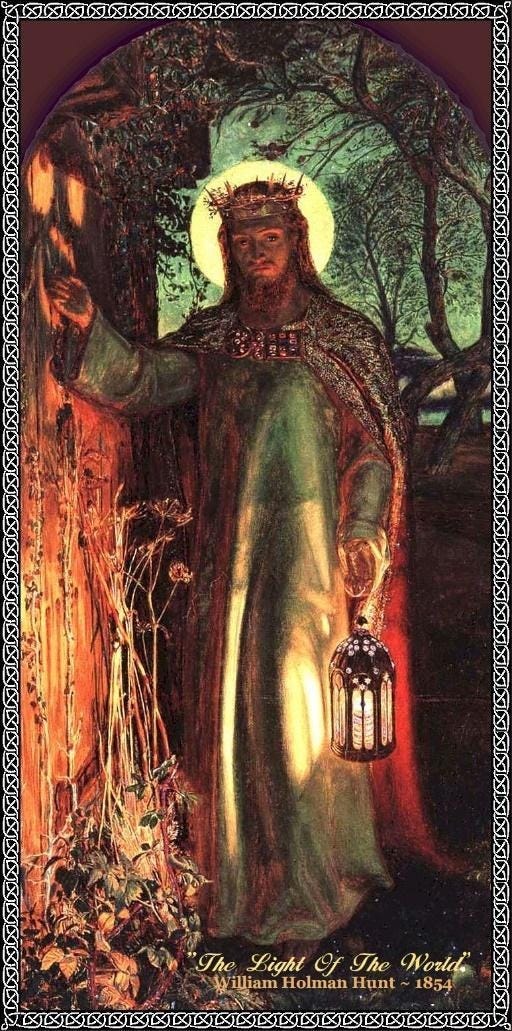
I will explain my inclusion of William Holman Hunt’s The Light of the World later.
Sources:
Wilson, Jennifer, A Grammar of Yeri: a Torricelli language of Papua New Guinea (Buffalo: New York State University 2017
The cheeky Google search
15:6
KJV. In the house of the righteous is much treasure: but in the revenues of the wicked is trouble.
Yeri. Tumani wdɨ worahal mani puyu sasapiten: tɨhelo wdɨ wual wodɨ mamigal.
in the house of the righteous is much treasure = tumani wdɨ worahal mani puyu sasapiten
tumani = house
wdɨ = of
worahal = cleaner bird
mani = inside
puyu = money
sasapiten = many
The worahal is a bird that is known for cleaning gardens. Wilson does not provide us with the Latin name, which is a shame.
By itself, puyu means rock, stone or money.
You can specify money by adding hɨrka to be green, new or shiny.
sapiten many often receives Reduplication on the first syllable for emphasis, becoming sasapiten.
in the revenue of the wicked is trouble = tɨhelo wdɨ wual wodɨ mamigal
tɨhelo = garden
wdɨ wual = a pig’s
wodɨ = has
mamigal = worms/caterpillars
The /tɨ/ on tɨhelo garden and the /tu/ on tumani house are the same, i.e. the Locative Prefix tɨ-, which appears on a limited number of nouns.
The /helo/ in tɨhelo comes (possibly) from helol work or year.
The /mani/ in tumani comes (certainly) from mani inside/be located inside something, which also appears in this verse.
One tɨhelo becomes two (or more) helol.
One tumani becomes two (or more) lapi.
wodɨ has three components:
1. w- = she (pig’s garden).
2. ode = and.
3. -i = they (worms and caterpillars).
In Yeri, ode and behaves like a verb.
I made tɨhelo garden Feminine because it is a Container, and Containers take Feminine Gender as the default.
In addition, Abstract Concepts also take Feminine Gender.
mamigal is the Plural form of mami caterpillar or worm found in river clay.
mami can also mean ancestress/-es, and will usually be followed by her name/s. (This second meaning has no separate plural form.
In addition, mami is but one vowel away from mame one of the two main yams.
15:7
KJV. The lips of the wise disperse knowledge: but the heart of the foolish doeth not so.
Yeri. Mulagɨl wdɨ iemaren nebal ahiwo yewal: wualebo wan hiro yotam.
the lips of the wise disperse knowledge = mulagɨl wdɨ iemaren nebal ahiwo yewal
mulagɨl wdɨ = the lips that
iemaren = prepare a garden
nebal = tree
ahiwo = sets
yewal = eyes
ahiwo has two components:
1. awo = to plant.
2. -hi- = them.
There is no Subject Prefix. Therefore it is they who are doing it.
Yeri awo = English to plant.
This is how Wilson defines awo in her dictionary: to set down something that has neither an overly long vertical axis not an overly long horizontal axis.
Yeri nebal yewal = English seeds.
I placed ahiwo between them in order to widen the scope.
You plant trees, and you sit on their branches, and this lets your eyes see the forest, instead of the trees.
the heart of the fool does not do this = wualebo wan hiro yotam
wualebo = a fool’s
wan = heart
hiro = [does] not
yotam = these things
these things has two forms in Yeri: yotai and yotam.
The typical form is yotai.
I use yotam, which the Yeri rarely use.
The fools do these things rarely.
15:8
KJV. The sacrifice of the wicked is an abomination to the LORD: but the prayer of the upright is his delight.
Yeri. Hasielagɨl wdɨ hamote wnagou wilau danuan Taliawik: parietɨ wdɨ worahal palpal wnobiadan.
the sacrifice of the wicked is an abomination to Yahweh = hasielagɨl wdɨ hamote wnagou wilau danuan Taliawik
hasielagɨl = flesh/meat.
wdɨ hamote = of the person
wnagou = that has a strong smell
wilau = is bad
danuan = towards him
Taliawik = Yahweh
sacrifice comes from Hebrew zawbakh (זבח) to slaughter for sacrifice.
wicked comes from Hebrew rawshaw (רשע) wicked or criminal.
I went with wnagou she (who) has a strong smell because it can go two ways:
1. she smells bad, because she has not washed.
2. she smells bad, because she is wearing too much perfume, trying to hide the rottenness inside.
I remind you that in Yeri, the Feminine Gender is the Default – the opposite of most European Languages.
I forget where, but C.S. Lewis says something along the lines of:
“We call her Mother Nature because she gives back what you put in.”
Any inaccuracies in the quote are my fault.
the prayer of the upright is his delight = parietɨ wdɨ worahal palpal wnobiadan
parietɨ = the song
wdɨ worahal = of the worahal
palpal = flying
wnobiadan = it speaks to him
I have decided that the worahal, a bird known for cleaning gardens, will be my Metaphor for Righteousness.
wnobiadan has three components:
1. w- = she.
2. nobia = speaks.
3. -dan = to him.
Yeri palpal to fly comes from the noise that a bird makes when she flaps her wings. When a bird flaps her wings, she dances in three dimensions.
The “Language of Birds” is a name given to the language that Adam and Eve spoke in the Garden of Eden.
15:9
KJV. The way of the wicked is an abomination unto the LORD: but he loveth him that followeth after righteousness.
Yeri. Yo wdɨ hamote wonekɨwal Taliawik: wan nomeda hamote wdɨ wiemar.
the way of the wicked is an abomination to Yahweh = yo wdɨ hamote wonekɨwal Taliawik
yo = the path
wdɨ hamote = of the person
wonekɨwal = it rejects him
Taliawik = Yahweh
Yeri yo = English road, path, door, hole.
It has several plural forms:
yo lapi = paths, roads.
yobaliagi = doors.
yo = holes.
Because it is followed by wdɨ, yo carries all of its possible English meanings at once.
wonekɨwal has three components:
1. w- = she/it.
2. okɨwal = push away, reject.
3. -ne- = him.
he loves him who loves righteousness = wan nomeda hamote wdɨ wiemar
wan nomeda = He loves
hamote = the person
wdɨ wiemar = who cleans a garden
Here, the main contrast is between the hamote individual, and the hamote wdɨ wiemar the individual who cleans a garden.
wan nomeda has four components:
1. wan = heart.
…
2. n- = he.
3. oda = is with (her).
4. -me- = always, still.
The Yeri Phrase wan oda the heart is with has several English translations:
1. to love.
2. to miss.
3. to think of.
4. to be happy with.
This other translation may help:
wan nomeda = his heart is with her.
15:10
KJV. Correction is grievous unto him that forsaketh the way: and he that hateth reproof shall die.
Yeri. Wia wdɨ nokɨrki nagou danua hamote wdɨ wonekɨwal yo: hamote wdɨ wonekɨwal wia wdɨ niebeko walmo.
correction is hateful to she who forsakes the way = wia wdɨ nokɨrki nagou danua hamote wdɨ wonekɨwal yo
wia wdɨ nokɨrki = correction
nagou danua = smells strongly to
hamote wdɨ = the person who
wonekɨwal yo = rejects the way
wia wdɨ nokɨrki correction has four components:
1. wia = the hand.
2. wdɨ = that.
…
3. n- = he.
4. okɨrki = helps.
okɨrki is very close to okɨrkai cross a river.
she who hates reproof will die = hamote wdɨ wonekɨwal wia wdɨ niebeko walmo
hamote = the person
wdɨ wonekɨwal = who pushes away
wia wdɨ niebeko = reproof
walmo = she will die
wia wdɨ niebeko reproof also has four components. The only one that differs from the above is:
4. iebeko = blocks.
I made both wia hands Masculine, because they belong to God. One hand stops you going the wrong way; the other helps you to go the right way.
Does one hand know what the other is doing?
Who can say?
Yeri use wia hand where English uses way or method.
I imagine that in a pre-industrial society, there is no separation between your hands and how you do things.