1 Samuel 23:26-29
A translation into Ngalakan
You can learn more about the now extinct Ngalakan language by following this link:

Of course, links to parts 2 and 3 of this series will be littered throughout.
Sources:
Merlan, Francesca, Ngalakan Grammar, Texts and Vocabulary (Australian National University 1983)
The cheeky Google and Wikipedia glances
Bible Hub (as always)
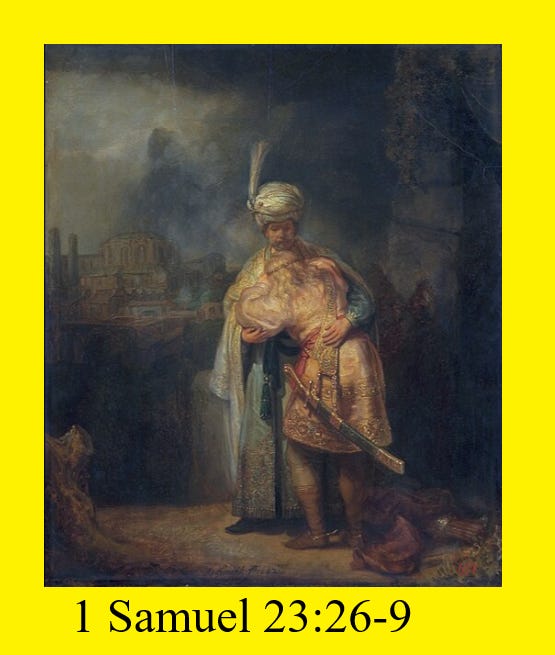
Picture: David and Jonathan by Rembrandt, 1642
1 Samuel 23:26
KJV: And Saul went on this side of the mountain, and David and his men on that side of the mountain: and David made haste to get away for fear of Saul; for Saul and his men compassed David and his men round about to take them.
Ngalakan: Gugala galagayañga’ ŗabo Ńugugaŋa bigurńowika’. Gugala galagojega’ Ńuguwaļga bigurńowika’. Ńuguwaļga wańabaţagepuni. Ńuguŋana bigurńowika’ waļuk burkańi’gin burujaŋaniñ añji bunbuwańamuń’ne.
Gugala galagayañga’ ŗabo Ńugugaŋa bigurńowika’ = Saul and his men went along one side of the mountain
Gugala = on the mountain.
galagayañga’ = on this side.
ŗabo = he went.
Ńugugaŋa = Saul.
bigurńowika’ = and his men.
“Mountain” comes from Hebrew har (הר) hill or mountain.
I use the Ngalakan word gu-gala mountain or high bank.
Curiously, this is only one letter away from gu-galal ceremony ground.
Now, the Hebrew uses missad (מצד) on the side twice in this verse. Most English translations use “one side” and “other side”.
I build galagayañga’ from two components:
1. gala- = side.
2. gayañga’ = on this.
Merlan wonders whether the Prefix gala- comes from the same gu-gala.
Part of me would like this to be the case. If you’re going to say /gala/ twice in a row, they may as well have the same meaning.
Gugala galagojega’ Ńuguwaļga bigurńowika’ = David and his men were on the other side.
Gugala = on the mountain.
galagojega’ = on the other side.
Ńuguwaļga = David (went).
bigurńowika’ = and his men.
Similarly, I built galagojega’ from three components:
1. gala- = side.
2. go’je = there.
3. -ga’ = Locative/Allative Suffix.
With the Demonstratives adverbs go’je there and go’ye here, the default meaning is Locative.
The Allative – direction towards – Suffix -gaga’ is largely a reduplication of the Locative.
Cutting to the chase, the final -ga’ is optional. I keep it here so that it rhymes with galagayañga on this side. This way, you get gugala followed by a 5-syllable word, and that regularity helps you speak it out loud.
These two adverbs, galagayañga’ and galagojega’, are the only words that use gala- as a Prefix.
Ńuguwaļga wańabaţagepuni = David wanted to get away from him.
I built wańabaţagepuni from three components:
1. wańa- = wanted, should.
2. baţa- = Object-Promotion.
3. gepuni = Potential Conjugation of gepu to get away from.
I briefly mention the Object-Promoting Prefixes under 1 Samuel 23:23.
To save you trouble of flicking back, the two Object-Promoting Prefixes are bak- and baţa-. There, I describe baţa- with the six-syllable word “Anti-Benefactive”.
More often than not, it just becomes “away” in English.
With some verbs, like gepu to elude, to get away from, the Prefix baţa- is optional but expected.
You may recognise the Prefix wańa-, which appeared all the way back in 1 Samuel 23:14, and which I referenced under the previous verse.
With a Potential verb, it means wanted to. With every other conjugation, it means continuously.
In case you are wondering, the Potential is very broad. It can mean any of the following: should, should have, want, wanted to, may or might.
In this case, wańa- simply clarifies which of those meanings is intended.

Ńuguŋana bigurńowika’ waļuk burkańi’gin burujaŋaniñ = Saul and his men were standing around them.
Ńuguŋana = Saul.
bigurńowika’ = and his men.
waļuk = all around.
burkańi’gin = them (lit. theirs).
burujaŋaniñ = they were standing.
Burujaŋaniñ has two components:
1. buru- = they.
2. jaŋaniñ = Past Continuous of ja to stand.
Ngalakan verbs are very simple. They have only five conjugations. For example:

As you can see, the only difference between ńa- sit and ja- stand is the first consonant. This is not the only time that /ń/ and /j/ alternate like this. Another example:

Before you ask, these prefixes cannot go with the previous verbs. Those verbs are intransitive, and these prefixes can only attach to transitive verbs.
Now, those weirdos who actually looked at the tables might have noticed that the 2nd Person Non-Singular – Singular Gu- Prefix is ńugu-, which is identical to the Masculine Long Prefix.
Similarily, the Feminine Long Prefix is jugu-.
Ngalakan has many Prefixes, and many of them look like each other. This is your warning.
añji bunbuwańamuń’ne = and they wanted to catch them
I built bunbuwańamuń’ne from three components:
1. bunbu- = they do to them.
2. wańa- = wanted to.
3. muń’ńe = Potential of muń’ to grab, catch hold of, grasp.
If you want to, you can swap bunbu- with buruńbu-.
Off the top of my head, I can name one Australian language that prefers words with an even number of syllables. In the spirit of referring back to previous things that I have written, this language is Yidiñ, in which I wrote my first ever translation of a full passage – Numbers 21:4-9 if I remember correctly – and you can find it somewhere in the back archives.
The style has evolved since then.
1 Samuel 23:27
KJV: But there came a messenger unto Saul, saying, Haste thee, and come; for the Philistines have invaded the land.
Ngalakan: Mubugu Ńugugaŋa’gan yaŋwo’wo, “Jar’jar’bawun’! Mamimamiñbuyi’ gunguguńɖu burugul’.”
Mubugu Ńugugaŋa’gan yaŋwuniñ = a message came to Saul, saying
Mubugu = a message.
Ńugugaŋa’gan = to Saul.
yaŋwuniñ = someone said to him.
“Messenger” comes from mah-lahk (מלאך) messenger, ambassador and most importantly angel.
The phrase mubugu yaŋwo’wo has three components:
1. mubugu = something to do with messages.
2. yaŋ = language, word.
3. wo’wo = he gave (Past Punctual).
This is an example of Noun incorporation.
The literal translation of yaŋwu is something like to give word, but it normally appears in the Reciprocal form yaŋwuyči to talk with or to converse with.
Anyway, wu to give belongs to a small class of verbs that use Reduplication in the Past Punctual.
This warns Saul, and the reader/listener, for the onslaught of reduplication that is on the way.
Jar’jar’bawun’! Mamimamiñbuyi’ gunguguńɖu burgugul’. = Make haste, the Philistines are invading the country.
Jar’jar’bawun’! = Come quickly”
Mamimamiñbuyi’ = the Philistines.
gunguguńɖu = the country.
burgugul’ = they are striking.
Jar’jar’bawun’ has two components:
1. jar’jar’ = to not want something.
2. bawun’ = leave.
Taken together, they become to leave something in a hurry.
“Philistine” comes from Hebrew peh-lish-tee (פלשתי), which comes from the name of their country peh-leh’-sheth (פלשת), and this comes from pah-lash (פלש) roll in dust or wallow.
I use the verb mamiñbu to wrap up or to roll up, specifically swag or a bed-roll.
Burgugul’ has two components:
1. burgu- = they do to it (Gu- Class).
2. gul’ = poke, jab, strike, shoot, strip off.
The last meaning strip off means that Ngakalak gul’ is very close Hebrew pah-shaht (פשט) to strip, make a raid.
The word first appears in Genesis 37:23, and is used to describe Joseph’s brothers stripping his coat of many colours.
The Hebrew phrase “the Philistines have invaded” has some nice alliteration. It goes pashetu pelishtim (פלשתים פשטו).
With the Ngalakan, I managed to sneak in the alliteration with they invaded the country: gunguguńɖu burgugul’.
Remember, the first word is pronounced gun-gu-guń-ɖu.
1 Samuel 23:28
KJV: Wherefore Saul returned from pursuing after David, and went against the Philistines: therefore they called the place Selahammahlekoth.
Ngalakan: Mubol’ Ńuguwaļga’gan mubawun’miñ, añji buruńbo’bo Mamimamiñbu. Warŋgu guŗomo guŋeybunubun Gubiń Guļakbuniñ.
Mubol’ Ńuguwaļga’gan mubawun’miñ, añji buruńbo’bo Mamimamiñbu = He abandoned his pursuit of David, and fought against the Philistines.
Mubol’ = track.
Ńuguwaļga’gan = David’s
mubawun’miñ = he abandoned it.
añji = and.
buruńbo’bo = he struck them.
Mamimamiñbu = Philistines.
I built mubawun’miñ from three components:
1. mu- = Mu-Class Absolutive Prefix.
2. bawun’ = abandon, leave.
3. -miñ = Past Punctual.
The mu- in component [1] references the mu- in mubol’ road or path.
In fact, the phrase Ńuguwaļga’gan mubol’ has two possible translations:
1. David’s track.
2. the path to David.
I built buruńbo’bo from two components:
1. buruń- = he does to them.
2. bo’bo = Past Punctual of bu hit, strike, kill.
I put both these verbs in the Past Punctual. The Bible doesn’t spend any time on this particular invasion, so our verbs skip over it as well.
Warŋgu guŗomo guŋeybunubun Gubiń Guļakbuniñ. = That is why the place is called the Gorge of Separations.
Warŋgu = that is why.
guŗomo = the same place.
guŋeybunubun = it is called (lit. one calls it).
Gubiń = the Rock.
Guļakbuniñ = that is split.
I don’t know if the /gu/ in warŋgu has anything to do with the gu- on every word that comes after it. Either way, I appreciate the extra alliteration.
Anyway, guŋeybunubun has three components:
1. gu- = Gu- Prefix.
2. ŋey = Name
3. bunubun = Present Tense of bu.
“Selahammahlekoth” comes from Hebrew seh-lah ham-makh-leh-koth (הםחלקות סלע). This has three components:
1. sela (סלע) = rock.
2. ha- (ה) = of (lit. the).
3. mahlekoth (מחלקות) = divisions.
This word for divisions first appears in Joshua 11:23 (BSB):
So Joshua took the entire land, in keeping with all that the LORD has spoken to Moses. And Joshua gave it as an inheritance to Israel according to the ALLOTMENTS of their tribes. Then the land had rest from war.
I built Gubiń Guļakbuniñ with four components:
1. gu- = Gu-Class Short Prefix. [x2].
2. biń = rock, hill, stone.
4. ļakbuniñ = Past Continuous of ļakbu to split.
This is the third appearance of bu in this verse.
I chose the Past Continuous buniñ because it almost rhymes with biń.
Well, it almost rhymes when a Native speaker says it: it definitely rhymes when your tongue tries to say it.

1 Samuel 23:29
KJV: And David went up from thence, and dwelt in strong holds at Engedi.
Ngalakan: Go’jewala Ńuguwaļga ŋal’miñ gugalaga’ Guŋañjula Jelejel’gen wańańaŋaniñ.
Go’jewala = from there.
Ńuguwaļga = David.
ŋal’miñ = he went.
gugalaga’ = on the high banks
Guŋañjula Jelejel’gen = (at) En-Gedi.
wańańaŋaniñ = and he dwelt.
This is the first time that I was able to end a passage with the same word that I begun it.
“En-Gedi” comes from an geh-dee (גדי עין), which has two components:
1. an (עין) = eyes.
2. geh-dee (גדי) = young goat.
The whole phrase means something like Fountain of a Kid.
I built Guŋañjula Jelejel’gen from the following:
1. guŋañjula = eye.
2. jelejel’ = whimbrel.
The Latin name for jelejel’ is Numenious phaeopus variegatus, which breeds in north-eastern Siberia in the summer, and spends its winter across India and Australia. The whimbrel is a grey bird that breeds across sub-arctic Asia and Europe, even as far south as Scotland.
Ngalakan does not have a word for “goat”. The Hebrew word geh-dee (גדי) young goat comes from the same word as gah-dah (גדה) border of a river, which itself comes from an unused word meaning cut off. The river cuts through land, creating the banks.
The whimbrel is a wading bird, i.e. it spends most of its times on the banks.
It was also, I admit, the first animal I found in Merlan’s dictionary that grazes by a river.
Here is the final appearance of the word geh-dee (גדי) young goat in the Old Testament:
The wolf will live with the lamb, and the leopard will lie down with the goat; the calf and young lion and fatling will be together, and a little child will lead them.
- Isaiah 11:6 BSB.
1 Samuel 23:29 is 1 Samuel 24:1 in the New Jerusalem Bible.
I prefer the King James Version. This is how 1 Samuel 24:1 goes in the KJV: And it came to pass, when Saul was returned from following the Philistines, that it was told him, saying, Behold, David is in the wilderness of En-gedi.
Personally, I feel that the NJB version 1 Samuel 24:1-2 is just too busy.