Proverbs 15:11-5
A Yeri translation
You can read my introduction to the language here:

Here is the previous newsletter:
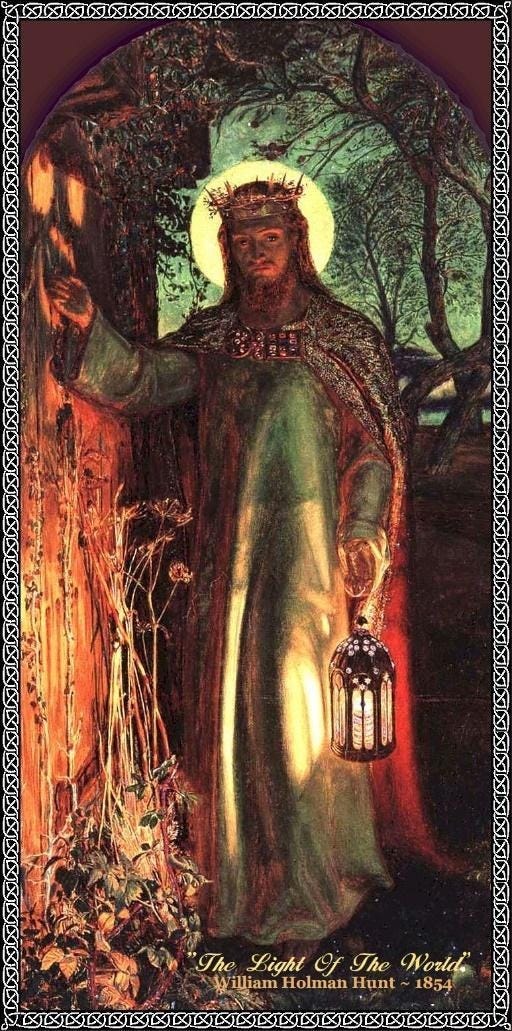
I will explain my inclusion of William Holman Hunt’s The Light of the World later.
Sources:
Wilson, Jennifer, A Grammar of Yeri: a Torricelli language of Papua New Guinea (Buffalo: New York State University 2017
The cheeky Google search
15:11
The King James makes the second part a question. The New Jerusalem does not. The original Hebrew is ambiguous.
I decided to follow the King James, because I want to make you ask then answer.
KJV. Hell and destruction are before the LORD: how much more then the hearts of the children of men?
Yeri. Dɨrdɨr hɨlhɨl dodi yewal Taliawik mani: wan nogolgoi hamei mai?
hell and destruction are before Yahweh = dɨrdɨr hɨlhɨl dodi yewal Taliawik mani
dɨrdɨr = Sheol/Hell
hɨlhɨl = Destruction
dodi = they stand
yewal = eyes
Taliawik = of Yahweh
mani = in
hell comes from Hebrew Sheol (שאול). This was the Underworld to which all Hebrew souls, both good and bad, went following death.
On the Saturday between Good Friday and Easter Sunday, Jesus went down to Sheol and opened the Road to Heaven.
Yeri dɨrdɨr = English to sit quietly.
It may come from the sound of someone tapping their finger while they wait for something.
destruction comes from Hebrew Abaddon (אבדון).
This roughly means Place of Destruction.
Yeri hɨlhɨl is the sound of a crackling fire.
I did not put an “and” between them because I want your tongue to trip over them when saying the verse out loud, because that’s how sin gets you.
how much more then the hearts of the children of men? = wan nogolgoi hamei mai?
wan = heart/s
nogolgoi = children
hamei = of men
mai = Y/N
One nɨgo child becomes multiple nogolgoi children.
One person is (female) hamote or (male) hamoten.
Two or more people are hamei.
mai turns any Sentence into a Yes/No Question.
This is different to the King James, which poses a Rhetorical Question.
15:12
KJV. A scorner loveth not one that reproveth him: neither will he go unto the wise.
Yeri. Wualebo hiro wiede hamote wdɨ wokɨrki: te hiro wer yokata.
a scoffer does not love he who corrects him = wualebo hiro wiede hamote wdɨ wokɨrki
wualebo = the fool
hiro wan wiede = does not love
hamote = the person
wdɨ wokɨrki = who helps (her)
scoffer comes from Hebrew loots (לוץ) to mock.
Curiously, the same word also means ambassador or interpreter.
The /ebo/ in wualebo fool comes from nebo dog.
Your dog is a very good boi or gal. He or she knows your state of mind better than you do. However, as soon as he or she wants to tell you something, it’s often all uphill.
he will not go to the wise = te hiro wer yokata
te = she
hiro = not
wer = will not go
yokata = (to the) wise.
Yeri 3rd Person Pronouns all begin with te she:
1. + -n = ten he.
2. + -i = ti they.
The yokata is a grey bird that has a very distinctive early-morning call.
I use it to translate wise because if you are going to make a lot of noise, the best time to do so is when the night-time predators are going to bed, and the day-time predators are still groggy and waking up.
15:13
KJV. A merry heart maketh a cheerful countenance: but by sorrow of the heart the spirit is broken.
Yeri. Mulagɨl sɨrsɨr nawia wan gɨlgɨlei: nabia bulbal wnawia wan bɨrbiar.
a merry heart makes a cheerful countenance = mulagɨl sɨrsɨr nawia wan gɨlgɨlei
mulagɨl sɨrsɨr = dancing lips
nawia = come out
wan gɨlgɨlei = (of) a bouncing heart
sɨrsɨr refers to people dancing.
It comes from the sound of boiling water, to which it also refers.
zealous comes from the Greek zēloō (ζηλοω), which also comes from the sound of boiling water.
Thus, Yeri sɨrsɨr = Greek ζηλοω.
sorrow breaks the spirit of the heart = nabia bulbal nawia wan bɨrbiar
nabia bulbal = a broken spirit
wnawia = comes out (of)
wan bɨrbiar = a twisted heart
bulbal break into many pieces usually refers to the way that branches break into many pieces when they fall from a tree.
It also sounds similar to brɨlbral, which refers to:
1. the sound of a fish flopping around on the ground.
2. to argue loudly.
15:14
KJV. The heart of him that hath understanding seeketh knowledge: but the mouth of fools feedeth on foolishness.
Yeri. Wan wdɨ galgal wgawo yewal: wualebo wan wonemo nihewo.
the heart of him with understanding seeks knowledge = wan wdɨ galgal wgawo yewal
wan = the heart
wdɨ galgal = that understands
wgawo = opens
yewal = the eyes
Yeri galgal = English to be strong, and to be dry.
The man or woman with understanding is not swept up by the river of worries, he stays on dry land, and when he must cross a river okɨrkai in order to help okɨrki someone, s/he does not fall in on the way there.
the mouth of fools feeds on foolishness = wualebo wan wonemo nihewo
wualebo = a fool’s
wan = heart
wonemo = she eats him
nihewo = smoke
wonemo has three components:
1. w- = she.
2. omo = is eating.
3. -ne- = him/it.
I make nihewo smoke Masculine to indicate that the fool’s heart eats a lot of smoke, but never gets any fuller.
In addition, the Yeri use nihewo for tobacco.
15:15
KJV. All the days of the afflicted are evil: but he that is of a merry heart hath a continual feast.
Yeri. Yikɨ yikɨ weidei yailuai neikia: wan wnaben nomo yikɨ yikɨ.
all the days of the afflicted are evil = yikɨ yikɨ weidei wdɨ yailuai neikia
yikɨ yikɨ = every day
weidei = of those that
yailuai = are deserving of sympathy
neikia = extinguishes (a fire)
afflicted or poor comes from Hebrew awnee (עני) be poor, be afflicted, be humble. In ancient Israelite society, it refers to a person who has no land, family (support), or other form of self-support.
What fire do their days extinguish?
That of hope.
one with a merry heart has a continual feast = wan wnaben nomo yikɨ yikɨ
wan = heart
wnaben = good
nomo = he eats
yikɨ yikɨ = every day
merry comes from Hebrew towb (טוב) good, pleasant etc…
I made the good heart wan wnaben Masculine because it is big, because it holds many people, and as it gets larger, it includes more people.
yikɨ yikɨ (lit. day day) is how the Yeri say every day.
I could not think of another way to say always or continually. This way, this phrase book ends the verse, and shows how the same thing can either serve God or lead you away from Him.