Proverbs 15:21-5
A Yeri translation
You can read the language introduction here:

Now, you must read on to discover the importance of this picture
Sources:
Wilson, Jennifer, A Grammar of Yeri: a Torricelli language of Papua New Guinea (Buffalo: New York State University 2017
The cheeky Google search
15:21
KJV. Folly is joy to him that is destitute of wisdom: but a man of understanding walketh uprightly.
Yeri. Wualebo hiro wiede wowi wdakiti: hamote wodɨ wowi wo tuakɨ.
folly makes him without discernment happy = wualebo hiro wiede wowi wdakiti
wualebo = a fool
hiro wiede = that has no
wowi = mind
wdakiti = is happy
Remember that wualebo fool is a combination of wual pig and nebo dog.
Yeri wowi = English mind and forehead.
This reminds me of the Men Without Chests chapter from The Abolition of Man by C.S. Lewis.
The Chest is the intermediary between the Heart and the Mind.
Perhaps the forehead serves a similar function. You need both Blunt Thinking and Subtle Thinking – the bow and the club.
a man of understanding walks uprightly = hamote wodɨ wowi wo tuakɨ
hamote = a person
wodɨ wowi = with a mind
wo tuakɨ = is a walking stick
Why do I refer to a person of understanding as a “walking stick”?
Because other people can lean on them.
15:22
KJV. Without counsel purposes are disappointed: but in the multitude of counsellers they are established.
Yeri. Hiro wigal weidɨ okɨrki ndɨhelia: odɨ wigal wdɨ wokɨrki nokɨrkai.
hiro = without
wigal = words
weidɨ okɨrki = that help
ndɨhelia = you wander aimlessly
odɨ wigal = with a (small) word
wdɨ wokɨrki = that helps
nokɨrkai = you cross a river
The n- in ndɨhelia and nokɨrkai can also mean he.
It was Eve who broke the rule first, and Adam followed her out of the Garden of Eden.
I put the unhelpful words in the Plural, because you are looking for them everywhere.
I put the helpful word in the Singular, because a single, sharp word can cut through the fog and confusion created by overlapping, confusing words.
I wanted to use okɨrki to help and okɨrkai to cross a river in the same verse, and I saw my opportunity here.
15:23
KJV. A man hath joy by the answer of his mouth: and a word spoken in due season, how good is it!
Yeri. Wigal tabi datikida hamote: wigal turtur no weinabei nadɨ.
a man has joy from the answer of his mouth = wigal tabi datikida hamote
wigal = words
tabi = mouth
datikida = plays with
hamote = person
mouth comes from Hebrew peh (פה) mouth, edge, portion, side and according to.
Yeri tabi = English mouth, opening.
Many verses in the Old Testament end with the letter pe (פ). Ancient Written Hebrew had neither punctuation nor spaces between words. You knew where they were because you had heard the Priests and Rabbis speak them aloud in the temple.
tabi is one Vowel away from tabu shoulder.
In turn, tabu is one De-Voicing and one Vowel away from tapo a hole in a tree.
The /i/ in tabi opening is a Front-Vowel – it comes from the front of the mouth.
/o/ and /u/ are Back Vowels – they come from the back of the mouth.
What is Voicing?
To simplify, a /p/ is a whispered /b/.
how good is a word spoken at the right moment = wigal turtur o weinabei nadɨ
wigal = words
turtur = beating
o weinabei = are good
nadɨ = only/very
The snake sits in the tapo, whispering to Eve. Then he pokes his head, out and drapes himself across her tabu. Soon, the fruit is opening her tabi, about to eat that fateful fruit.
Yeri turtur = English beating (esp. of a heart).
Words that come directly from the heart may not be the most direct, or the most efficient, but are always the most fruitful – at least in the long term.
nadɨ can mean only or very, depending on context.
While it may seem strange, where very becomes only is a matter of degree, not in kind.
15:24
KJV. The way of life is above to the wise, that he may depart from hell beneath.
Yeri. Yo wdɨ worahal wdɨnagou tɨhewar; hiro wdewo waltɨgɨl tɨhewo.
the way of the wise winds upwards = yo wdɨ worahal wdɨnagou tɨhewar
yo wdɨ = the way of
worahal = the worahal
wdɨnagou = flies
tɨhewar = upriver
Yeri dɨnagou = English to go all the way to the top of a hill or mountain.
A waltɨ is any body of deep water.
You have birds, mountains, rivers and a lake. Take a moment, and let the imagery live in your head for a little bit. It won’t pay rent, and you’ll be the richer for it.
so that he may depart from hell = hiro wdewo tɨhewo
hiro = not
wdewo = she will (not) sit
waltɨgɨl = in the deep water
tɨhewo = downriver
15:25
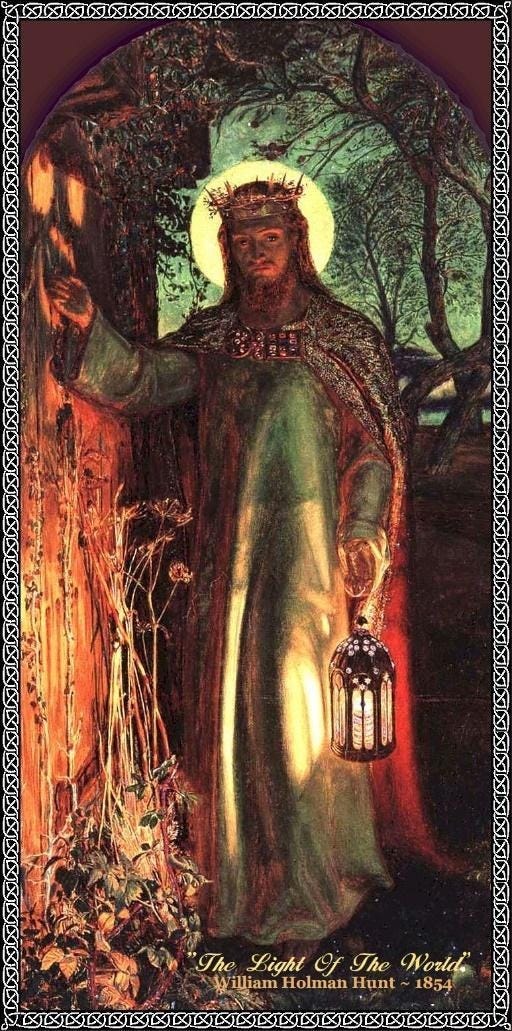
Something happened between writing this and the previous verse – I got baptised and confirmed. The Bishopess who presided made her sermon about Jesus knocking on your door. She used the Holman Hunt’s painting as an example, and she gave all of us Confirmation Candidates (myself included) an A5 copy thereof – printed on card no less.
Be still for the presence of the Lord was one of the hymns, and that is one of my favourites.
KJV. The LORD will destroy the house of the proud: but he will establish the border of the widow.
Yeri. Lapi gɨlgɨlei narobiai Taliawik: ta nawera halma wdɨ hiwora nanala.
Yahweh will destroy the house of the proud = lapi gɨlgɨlei narobiai Taliawik
lapi = house/s
gɨlgɨlei = bouncing
narobiai = He will destroy them
Taliawik = Yahweh
proud comes from Hebrew gawaw (גאה) to rise up, to be exalted, to triumph.
Not only does gɨlgɨlei appear in this example sentence from Wilson’s grammar:
Ten neikia gɨlgɨlei. = He walks proudly,
but it also makes you think of someone jumping up and down, trying to get God’s attention, thinking that God can see only a few things at a time, rather than everything.
narobiai has three components:
1. n- = he.
2, arobia = destroy, tear down.
3. -i = them.
I use the Plural Object Marker because:
lapi/lapi = house/s
lapi/lapigal = non-venomous snake/s.
In Yeri, Gender often indicates a physical property. To simplify:
Masculine – long and thin
Feminine – small and round, and also most containers.
When it comes to larger and domesticated animals, Grammatical Gender is based off Natural Sex.
A snake is neither large nor domesticated. They hide themselves very well, usually with some degree of camouflage, so you can’t always see the whole thing.
A house is a container – it contains people and their possessions. However, it is larger than a snake. If your house is smaller than a snake, it’s probably the end the world.
In summary, I was unsure what Gender to make lapi house, so I used the Plural to avoid the issue.
he will establish the boundary of the widow = ta nawera halma wdɨ hiwora nanala
ta nawera = he will lay down
halma wdɨ = the land of
hiwora nanala = the widow
Ta is the Future Tense Marker.
La is the Past Tense Marker.
Both widow and widower comes from Hebrew alahm (עלם) to be hidden, to be tongue-tied. This refers to the difficulty of many widowed people in getting help in the ancient world – the loss of a wife or husband was a far bigger economic hit.
I built hiwora nanala thus:
hiwora = wife.
nanala = alone, by herself.
To make widower, you can say megual nanala.